Field briefing
Standard weights let people compare materials and tests without arguing over handfuls, baskets, or guesses. They are a measurement tool and an institution.
What you are trying to make
Create reference masses that can be copied, protected, and used with a balance to compare unknown loads.
Minimum viable version
Matched stones and a simple balance can support workshop comparisons even if they are not legal trade standards.
Better versions
Better systems use durable marked weights, nested multiples, official custody, periodic comparison, and written records.
Prerequisite tree
- Lever for the balance principle.
- Counting for units and multiples.
- Writing for custody and calibration records.
Materials and sourcing
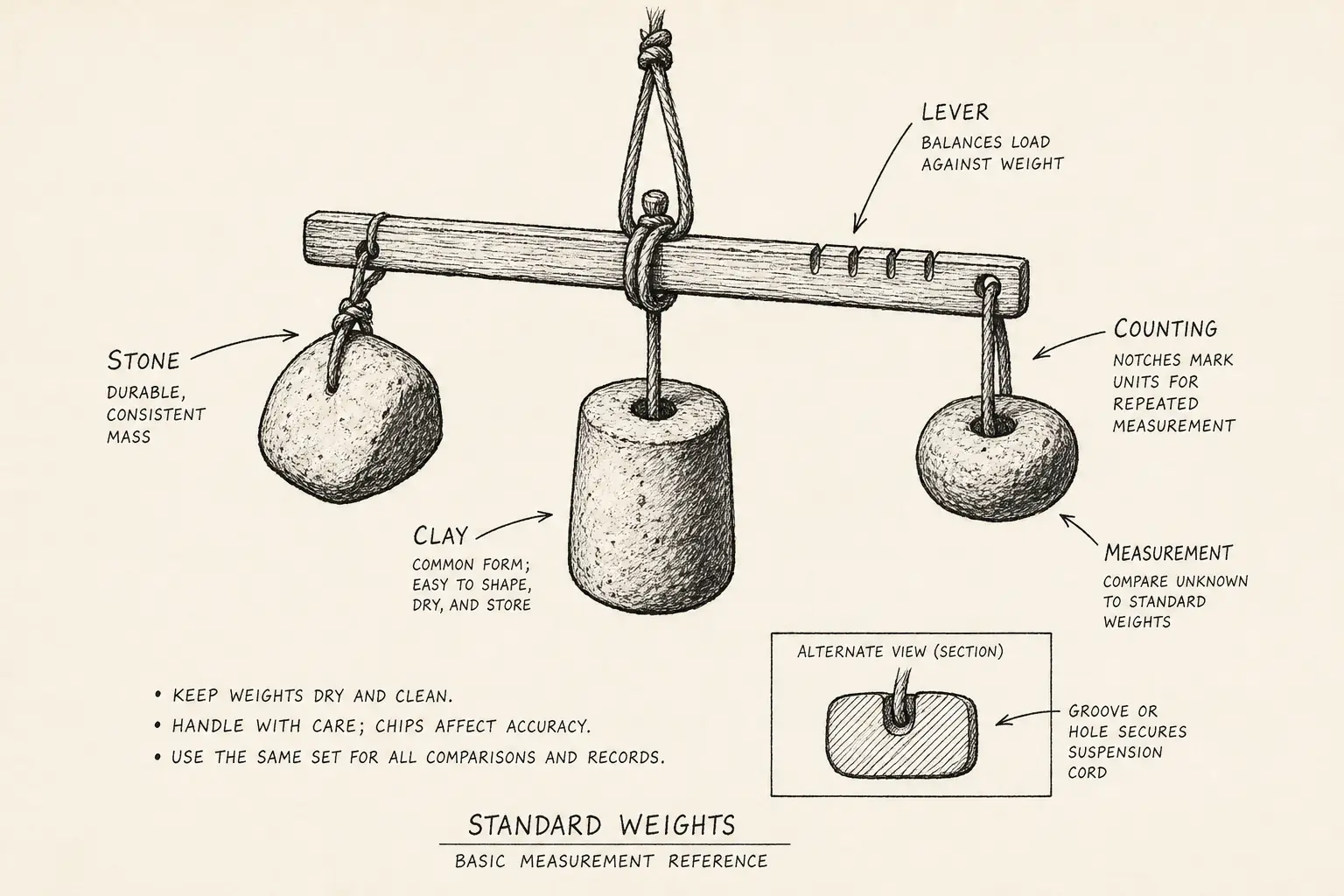
Stone is easiest: select dense, hard pieces that do not flake. Fired clay is possible but may chip or absorb moisture unless well made. Metal is excellent but demands more supply chain.
Recognition is practical: a candidate weight should survive handling, stay dry, take a mark, and balance the same reference repeatedly.
Tools and workshop requirements
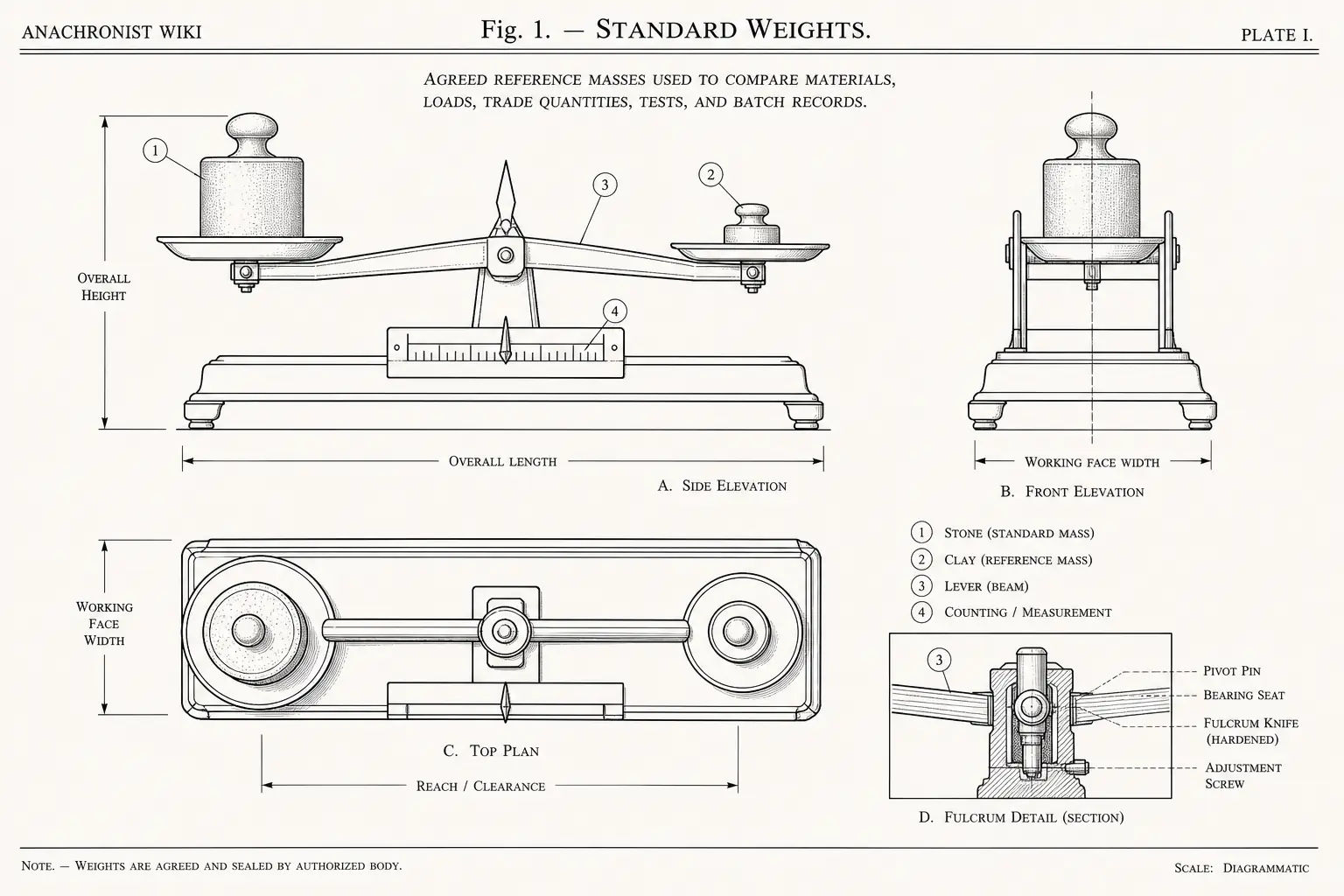
Tools include a balance beam, suspension cord, pans, marker, storage box, and a rule that master weights are not ordinary shop objects.
Procedure
- Select a master object for the first local unit.
- Make duplicates by comparison on a balance.
- Mark each weight clearly.
- Store masters separately from working copies.
- Recheck working weights against masters on a schedule.
Mechanism
A balance compares gravitational pull on two sides of a lever. Equal arms make equal masses balance.
Verification and quality control
Swap the pans and repeat the comparison. If the result changes, the balance is biased. Compare weights in combinations to catch drift or fraud.
Failure modes
| Failure | Likely cause | Fix |
|---|---|---|
| Weights drift | Wear, chipping, moisture | Protect and recheck |
| Balance lies | Unequal arms or friction | Reverse loads and repair |
| Disputes persist | No custody rule | Assign keeper and records |
Maintenance, repair, and iteration
Keep master weights wrapped, dry, and marked. Replace damaged working weights rather than silently correcting them.
Teaching it to local collaborators
Show that one stone can stand for a repeatable amount only if everyone agrees to protect and copy it consistently.
Historical plausibility
Weights arise naturally with trade, taxation, rations, medicine, and workshops. The bottleneck is authority and trust, not the physical stone.
What this unlocks
Standard weights unlock trade measures, proof loads for tensile tests, recipes where safe, and repeatable material comparisons.
Open questions and uncertainties
- Local historical units and materials need source review.
- A future page should cover length standards and calibration chains.
Sources and provenance
Generated seed draft for ANA-13. No source pack was used; specific claims need human source review.