Field briefing
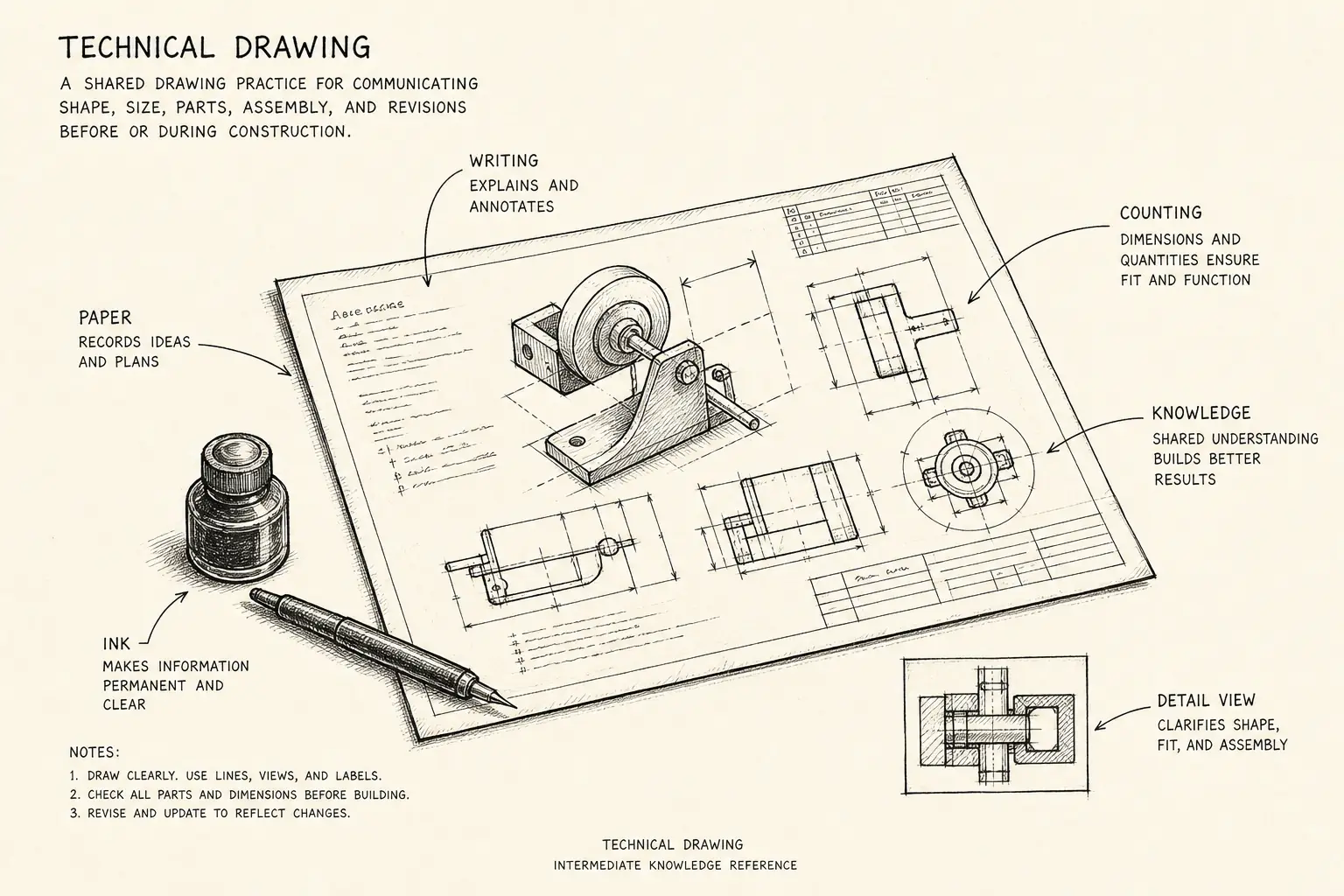
Technical drawing lets a workshop build from a shared picture instead of a single maker’s memory. It is most useful when parts must be copied, repaired, or taught.
What you are trying to make
Create drawings that preserve shape, relative size, assembly order, and important measurements well enough for another worker to act.
Minimum viable version
A labeled sketch with a few checked dimensions can improve a wheel and axle frame or pulley block.
Better versions
Better drawings use standard views, scale marks, material notes, revision dates, and a filing habit.
Prerequisite tree
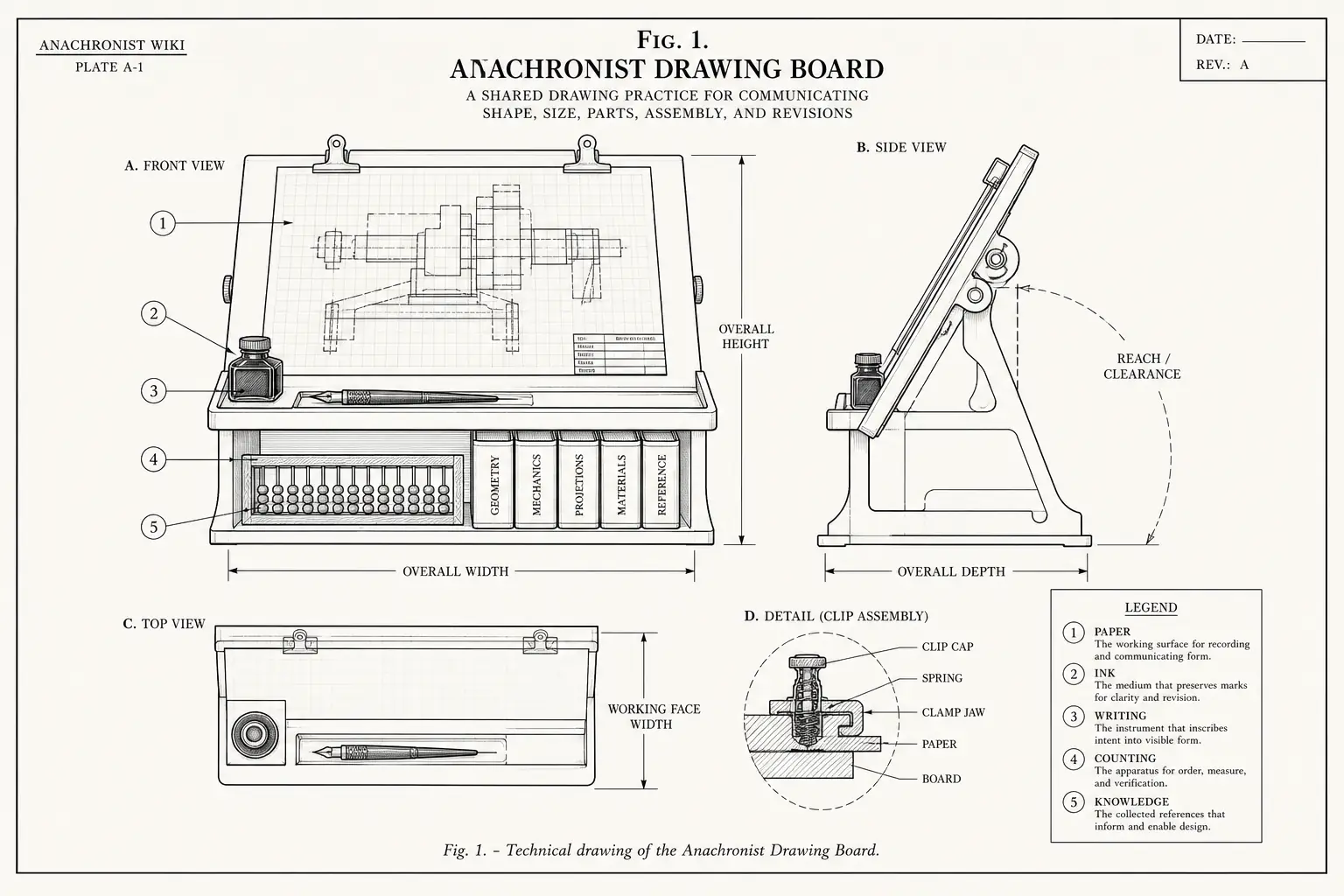
- Counting for dimensions and parts.
- Writing for labels.
- Paper and ink where available, with alternatives for earlier contexts.
Materials and sourcing
Drawing surfaces can be paper, parchment, wax tablet, smoothed board, scraped bone, or clay tablet. The supply chain depends on how long the drawing must last and how often it must be copied.
Ink, charcoal, scratched lines, and scored clay all work differently. A shop should choose marks that survive handling but can still be revised when the design changes.
Tools and workshop requirements
Tools include straightedges, cords, dividers, marking points, measuring rods, and storage. The workshop requirement is agreement: the same mark must mean the same thing to different workers.
Procedure
- Draw the object from the side that matters most.
- Add a second view when hidden shape matters.
- Mark centerlines, holes, and contact surfaces.
- Add dimensions only where the maker must match a size.
- Label material, batch, and revision.
- Check the drawing against the finished object.
Mechanism
Drawing converts spatial memory into external records. It lowers the cost of copying and makes mistakes visible before labor is spent.
Verification and quality control
Ask another worker to build a small part from the drawing. Any question they ask identifies a missing convention or note.
Failure modes
| Failure | Likely cause | Fix |
|---|---|---|
| Ambiguous shape | One view only | Add a second view or section |
| Wrong scale | No reference mark | Add a scale bar or dimensions |
| Lost revisions | No date or author | Add revision records |
| Unbuildable drawing | No material or process note | Add shop constraints |
Maintenance, repair, and iteration
Archive successful drawings near related tools. Mark obsolete drawings so they do not create bad copies.
Teaching it to local collaborators
Begin with familiar objects: lever, wheel, rope hook, kiln shelf. Teach centerline, edge, hole, thickness, and note.
Historical plausibility
Technical drawing can exist before modern projection systems, but it depends on literacy, measurement practice, and workshops that copy designs.
What this unlocks
Technical drawing unlocks repeatable machines, repair manuals, templates, teaching diagrams, and safer construction review.
Open questions and uncertainties
- Historical drawing conventions need source review.
- Future pages should cover length standards, compasses, straightedges, and scale models.
Sources and provenance
Generated seed draft for ANA-13. No source pack was used; specific claims need human source review.