Field briefing
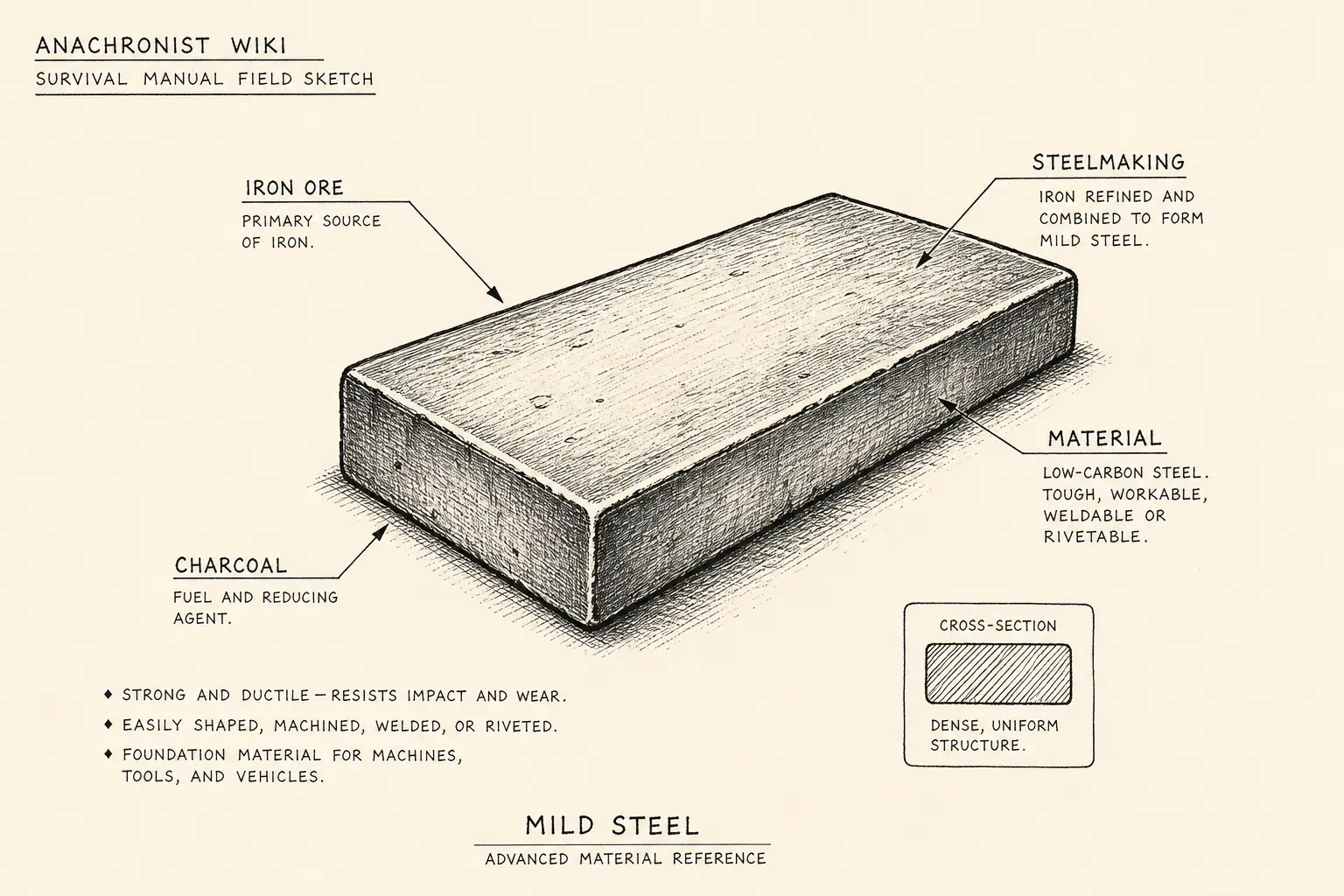
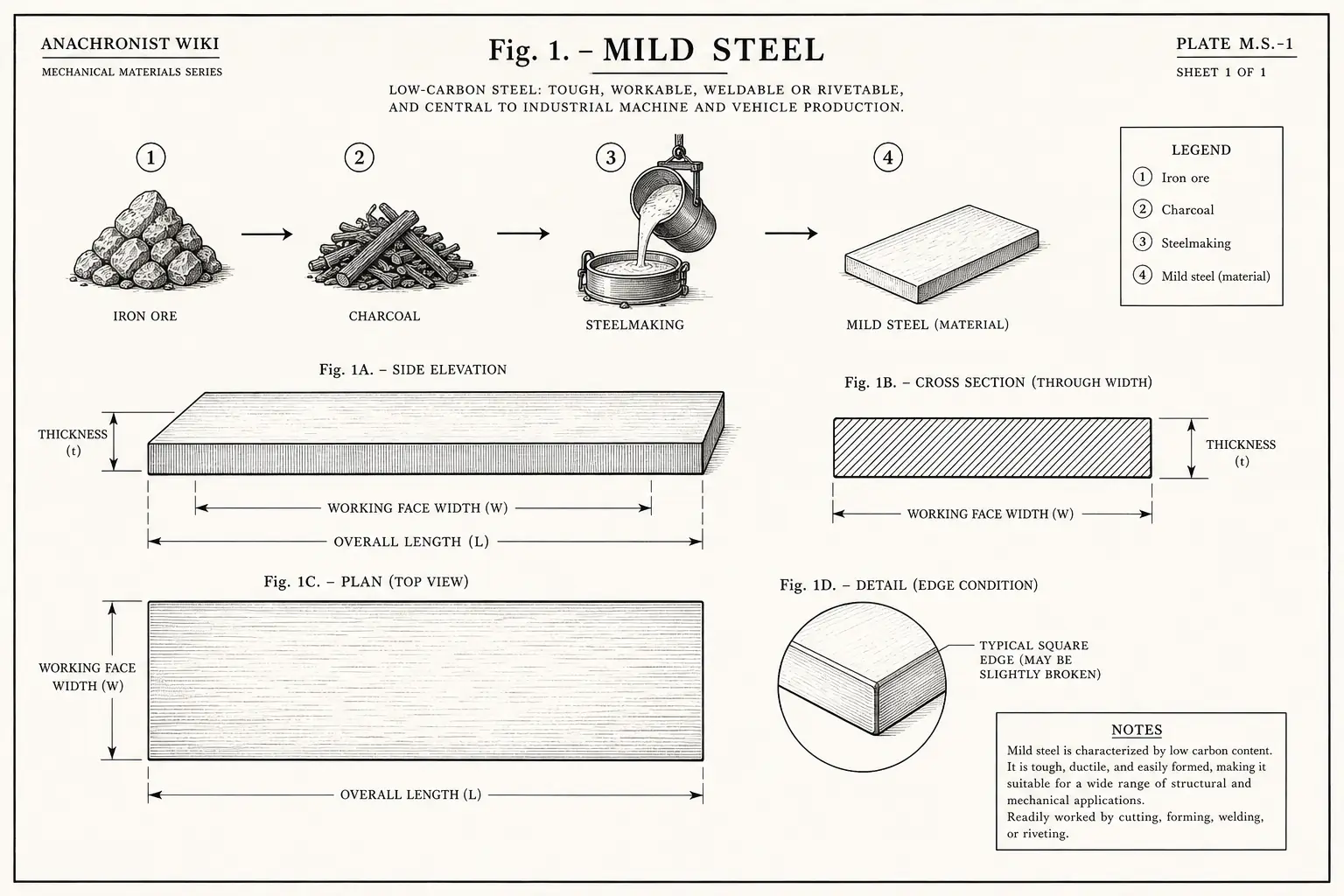
Low-carbon steel that is tough, workable, weldable or rivetable, and central to industrial machine and vehicle production.
For an anachronist technology tree, the useful target is not a museum-perfect reproduction. It is a path through materials, tools, measurements, records, and institutions that makes the capability understandable and auditable.
What you are trying to make
Build or specify a dependable early version of mild steel that can be inspected, repaired, and taught in a workshop or factory setting. The first version should prove the core relationship before chasing speed, power, comfort, or mass production.
Minimum viable version
A minimum version demonstrates the working principle with conservative loads, visible parts, and simple access for inspection. It should use known materials, avoid hidden failure modes, and leave enough records that another workshop can repeat the successful parts of the build.
Better versions
| Version | Added capability | Main new dependency |
|---|---|---|
| Bench or pattern version | Proves geometry, fit, and sequence without full service loads | [[technical-drawing |
| Workshop version | Works repeatedly with inspection and repair access | [[quality-control-records |
| Factory version | Can be made and serviced in quantity | [[interchangeable-parts |
Materials and sourcing
- Iron ore (hard): Iron supply is foundational.
- Charcoal (substitute): Early iron processes can use charcoal before coke-based industry.
Materials should be tracked by source, batch, preparation, substitutes, storage limits, and local geography. For vehicle-scale work, the social supply chain matters as much as the physical stock.
Prerequisite tree
- Iron ore: Provides iron feedstock.
- Steelmaking: Controls carbon and impurities.
- Standard weights: Supports batch and charge consistency.
- Quality-control records: Tracks heats, suppliers, and defects.
These edges are explicit graph relationships. Prose wikilinks provide reading paths, but the frontmatter edges are the source of graph truth.
Verification and quality control
Use fit checks, visual inspection, batch labels, and conservative proof tests before trusting this node in a larger vehicle. Keep inspection records close to the part or process so failures can be traced back to material, tooling, training, or design changes.
Edges left as empty pages
- Steelmaking: A metallurgy process page should cover steel production at a high level.
Where it leads
This node supports later automobile, factory, repair, and transport systems. It is most useful when paired with Workshop organization, Technical drawing, and Quality-control records.