Field briefing
Counting lets a group repeat work without relying on vague memory. It is a prerequisite for standards, inventories, batch tests, and teaching.
What you are trying to make
Create a shared way to answer how many, which order, how much more, and whether two collections match.
Minimum viable version
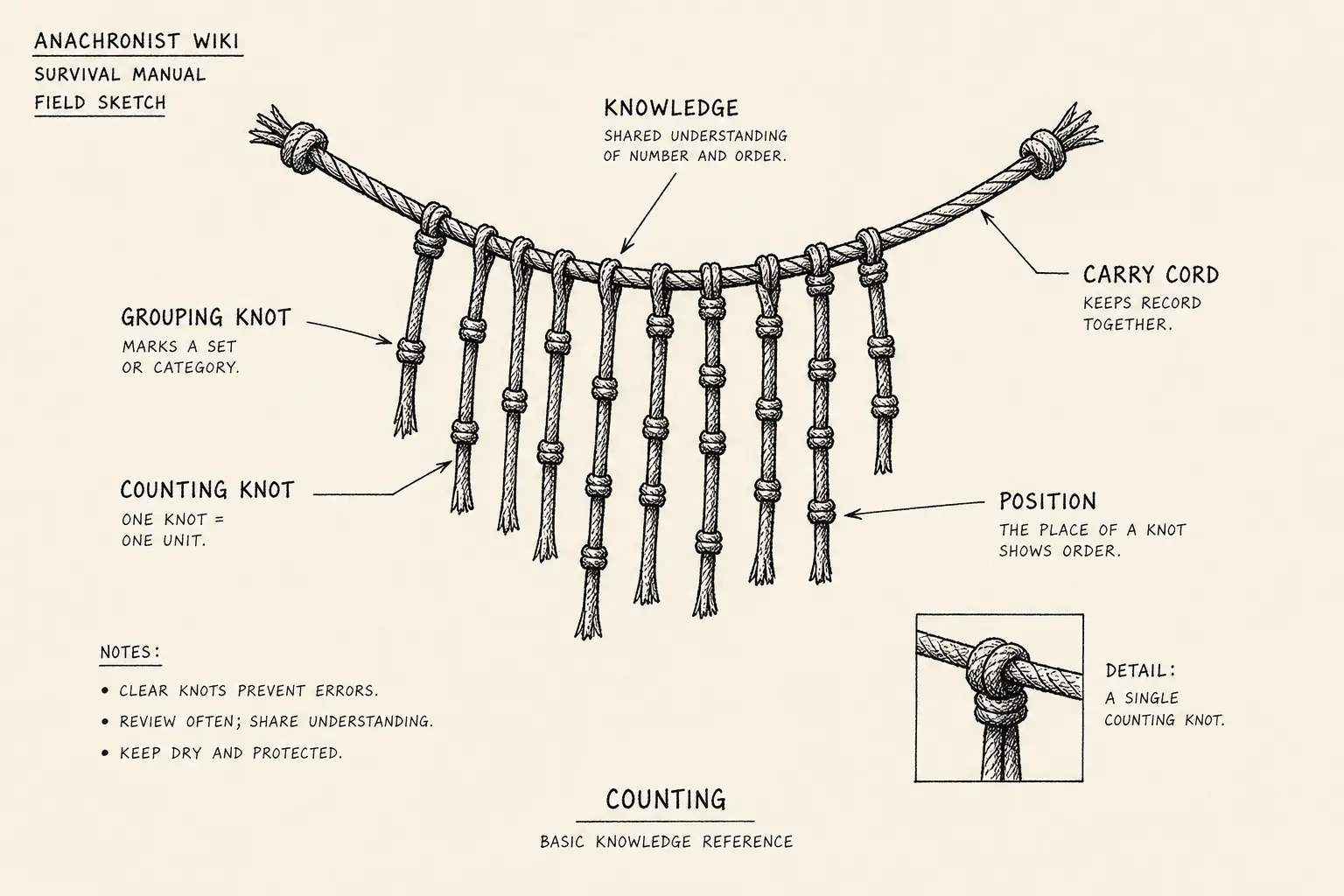
Fingers, stones, notches, knots, or tally marks are enough for small counts.
Better versions
Better counting adds place value or grouping, named units, written numerals, and checking routines.
Prerequisite tree
- No material prerequisite for the first version.
- Writing improves durability.
- Standard weights give counting a physical metrology role.
Materials and sourcing
Counting can be taught with stones, sticks, bones, knots, clay tokens, or marks. The supply chain requirement is sameness: counters should be distinct enough to see and durable enough to store.
Tools and workshop requirements
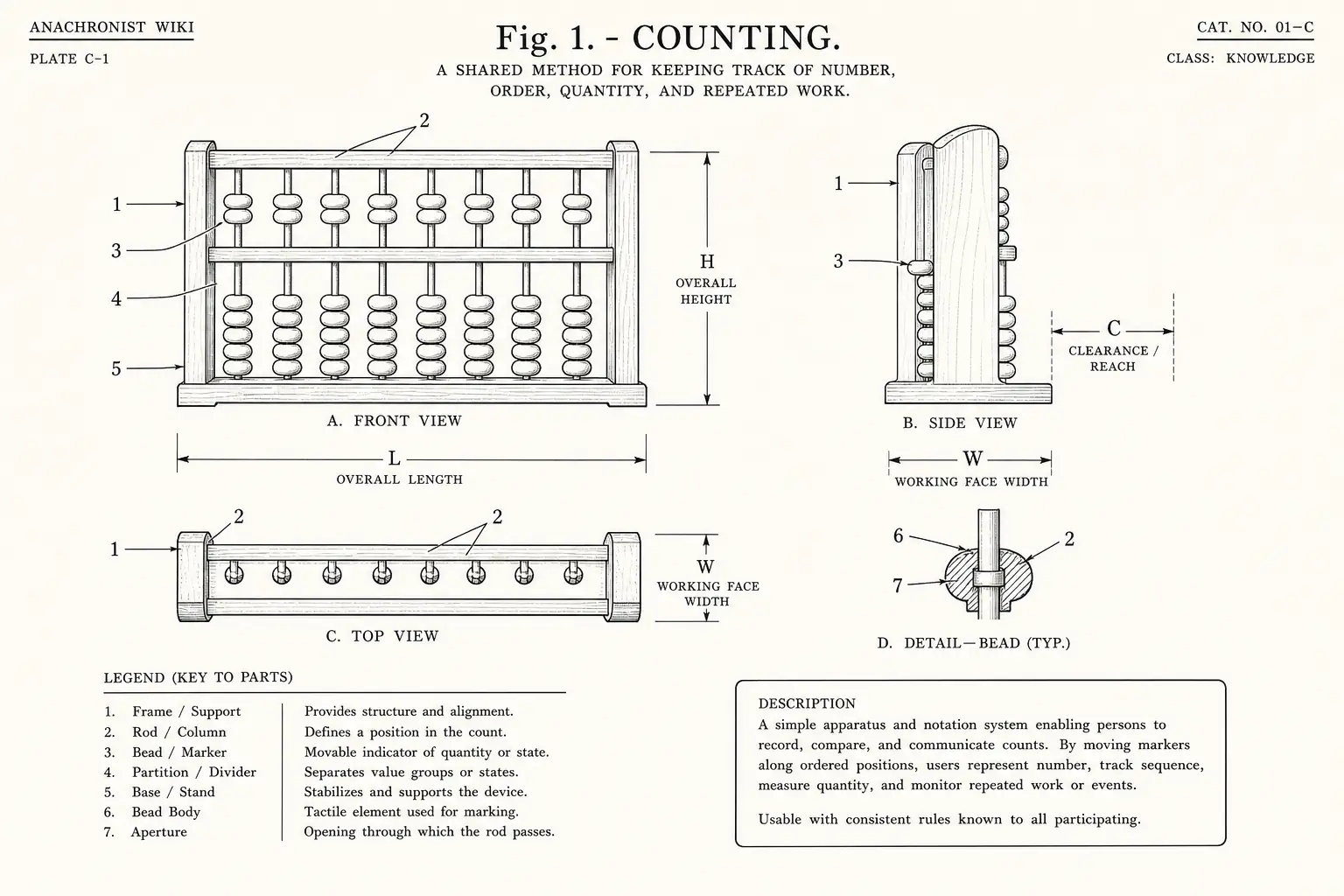
Use a counting board, tally stick, cord with knots, or marked clay tokens. A workshop should keep master examples for units, batches, and common bundles.
Procedure
- Establish one-to-one matching with objects.
- Teach grouping for larger counts.
- Use tallies for records.
- Check by recounting in a different order.
- Add names or signs only after the group understands the physical count.
Mechanism
Counting maps many objects to a repeatable sequence. It lets two people compare quantities even when the objects differ.
Verification and quality control
Have two people count the same pile separately. If results differ, use grouping or physical counters to find the error.
Failure modes
| Failure | Likely cause | Fix |
|---|---|---|
| Miscount | No grouping or distraction | Bundle in groups and recount |
| Tally ambiguity | Marks too similar | Use clear separators |
| Fraud or dispute | No witnesses or standards | Use paired records and seals |
Maintenance, repair, and iteration
Keep teaching examples. Review counting records against actual stock, especially for grain, fiber, fuel, and tools.
Teaching it to local collaborators
Teach through workshop needs: fibers per rope, sheets per batch, weights on a balance, and days since a firing.
Historical plausibility
Counting is widely plausible, but high-volume administration needs social trust, trained record keepers, and durable media.
What this unlocks
Counting unlocks writing, standard weights, measurements, stock control, and repeatable tests.
Open questions and uncertainties
- Future pages should compare tally sticks, tokens, abacus-like boards, and place value.
Sources and provenance
Generated seed draft for ANA-13. No source pack was used; specific claims need human source review.