Field briefing
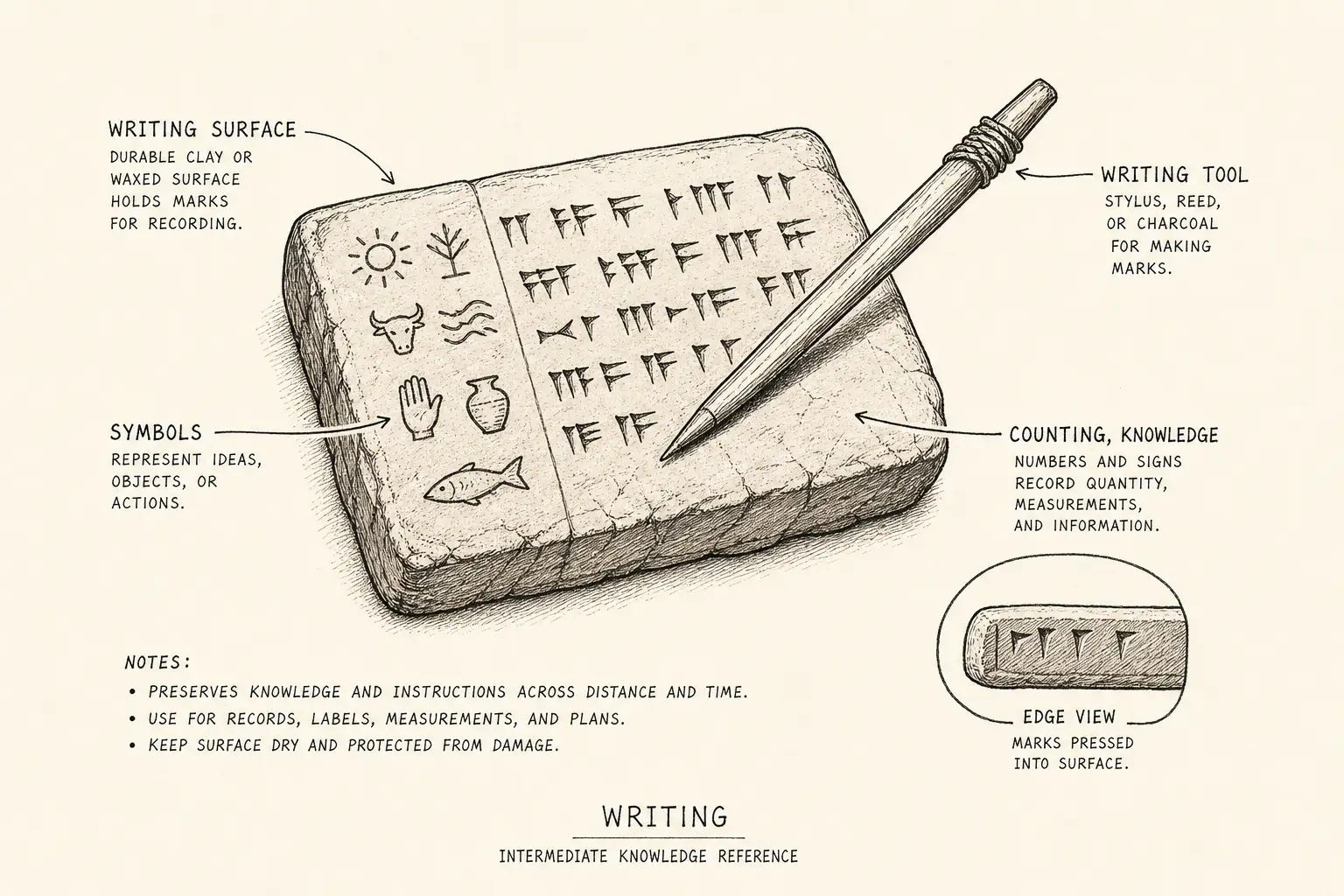
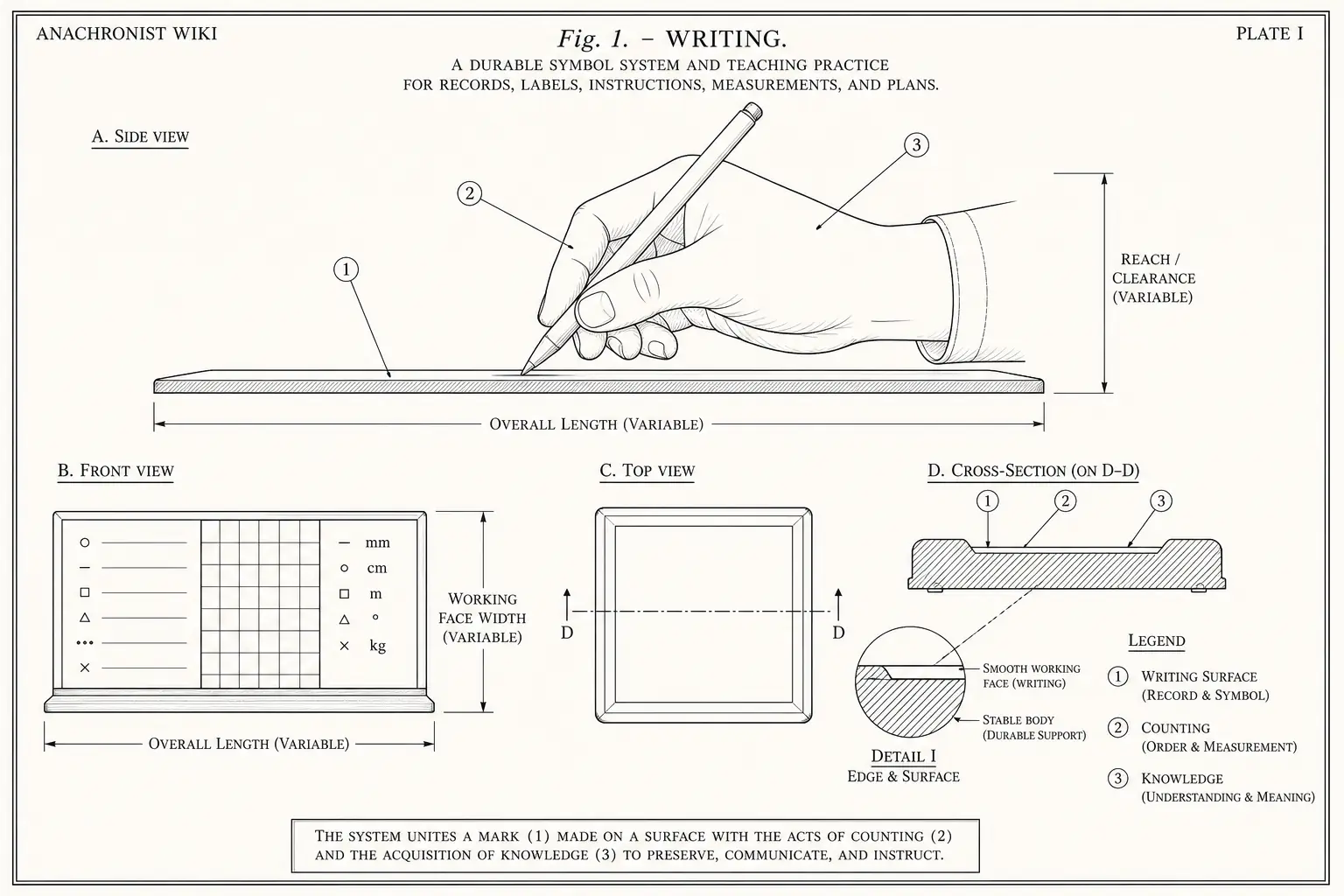
Writing is not just marks. It is a repeatable agreement that marks stand for speech, counts, names, places, batches, or instructions.
What you are trying to make
Create a symbol set, a teaching routine, and a storage habit good enough for a workshop to recover information after memory fails.
Minimum viable version
The first useful system can be tally marks, owner marks, batch symbols, and a short list of agreed labels.
Better versions
Better writing has consistent signs, trained readers, date or sequence marks, durable media, and copy checking.
Prerequisite tree
- Counting for tallies and quantities.
- Ink, clay, wax, wood, or another marking medium.
- A social reason to preserve records.
Materials and sourcing
Writing needs surfaces and marking tools. Clay tablets are heavy but local where clay exists. Paper is lighter but requires a fiber workshop. Wood, bark, wax, and parchment may be better early choices depending on local materials and livestock.
The important supply chain is not only material; it is storage. Records lost to damp, fire, theft, or confusion do not function.
Tools and workshop requirements
Tools can be as simple as a stylus, brush, pen, charcoal stick, or scratched mark. A mature record system needs shelves, labels, copies of critical records, and someone responsible for training.
Procedure
- Start with labels for people, places, materials, and batches.
- Use counting marks before abstract words.
- Keep sign shapes few enough that learners can copy them accurately.
- Store examples as the local standard.
- Check copied records against originals.
Mechanism
Writing externalizes memory. It allows instructions and measurements to survive absence, death, travel, and disputes.
Verification and quality control
Give the same record to two trained readers and ask what it says. If they disagree, the system is not yet reliable. Check whether records survive the storage conditions they will actually face.
Failure modes
| Failure | Likely cause | Fix |
|---|---|---|
| Marks vary too much | No exemplars or training | Keep model signs |
| Records cannot be found | Poor filing | Add labels and storage order |
| Symbols drift | No checking | Compare copies to masters |
| Only one reader exists | Knowledge bottleneck | Train apprentices |
Maintenance, repair, and iteration
Maintain a sign list and preserve master records. Add new symbols slowly, with examples.
Teaching it to local collaborators
Teach writing through useful records: debts, seed stores, tool loans, kiln batches, and dimensions. Avoid making it look like decorative magic.
Historical plausibility
Writing appears where administration, trade, ritual, or workshop records justify specialists. The bottleneck is often institution and training, not the physical mark.
What this unlocks
Writing unlocks accounting, standards, legal memory, technical drawing, safer sanitation norms, and multi-generation craft improvement.
Open questions and uncertainties
- Script choice and historical transmission need human review.
- Future pages should cover tally sticks, wax tablets, and apprenticeship records.
Sources and provenance
Generated seed draft for ANA-13. No source pack was used; specific claims need human source review.