Field briefing
A lever is the quickest useful machine: a stiff bar, a support point, and a load. It matters because it teaches the trade between force and movement before a workshop has formal mathematics.
What you are trying to make
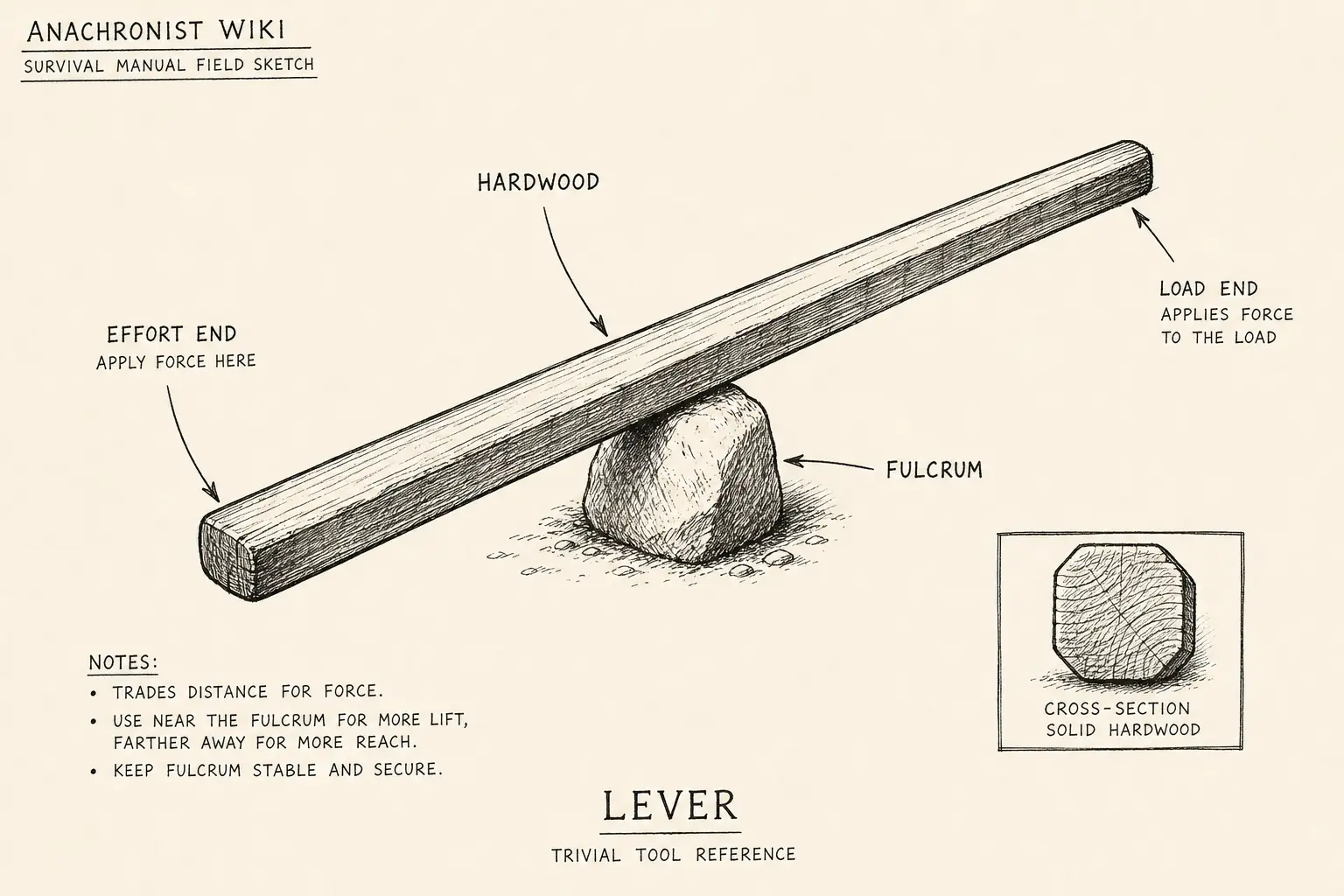
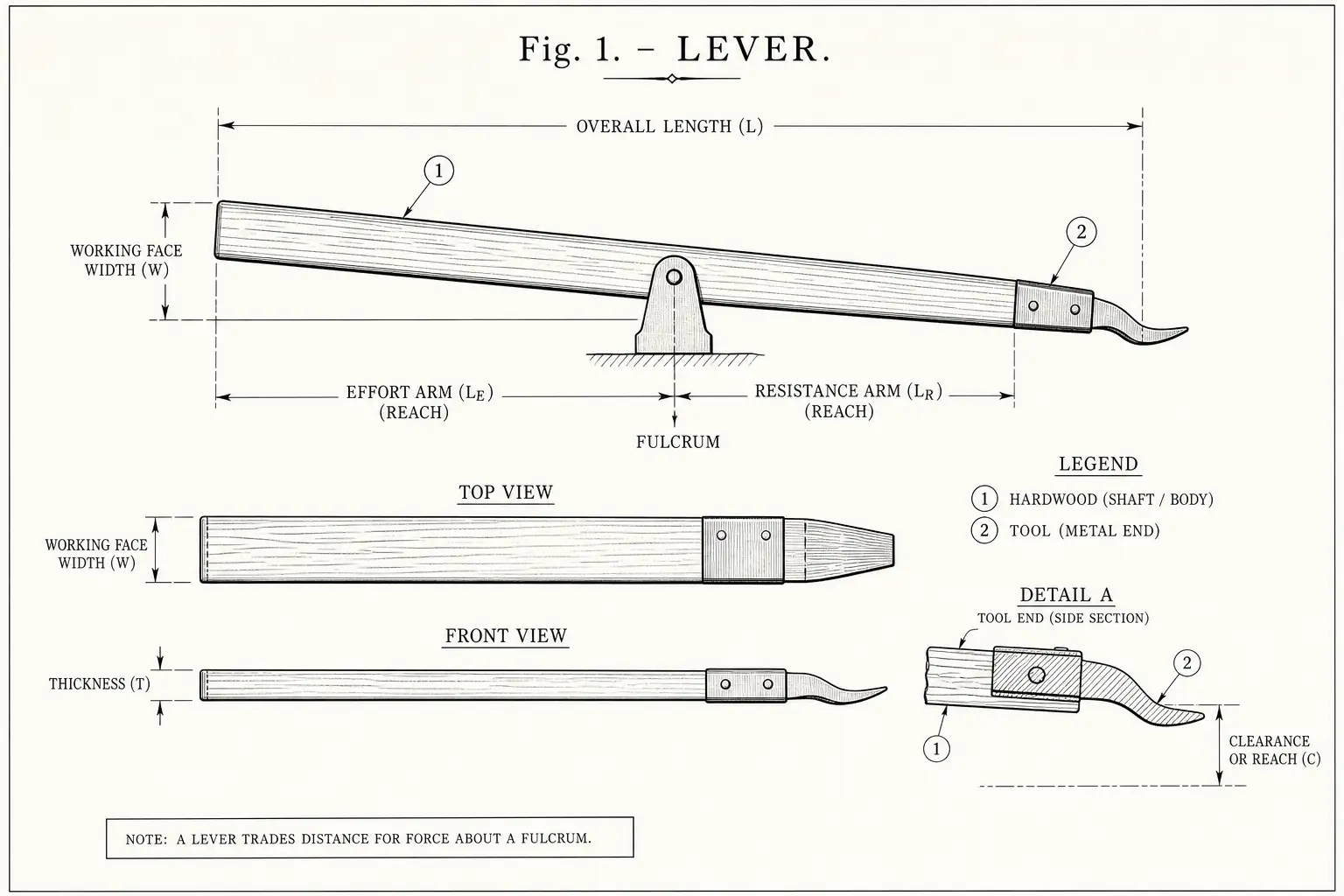
Make a bar that does not bend much under the intended load, then place it over a fulcrum so one end moves farther than the load end. The longer handle gives better force advantage but requires more travel.
Minimum viable version
A branch, pole, bone, or iron bar can work. The fulcrum can be a stone, log, block, or another tool.
Better versions
Better levers have smoother bearing surfaces, replaceable tips, and marked positions so workers can repeat the same setup.
Prerequisite tree
- No formal prerequisite is required for the first version.
- Counting helps compare load, distance, and repeated trial results.
- Standard weights turn a lever into a balance or test rig.
Materials and sourcing
Look for straight-grained wood with few knots. A good field test is to press the bar between two supports and watch whether it springs back instead of cracking. Dense hardwood lasts longer at the fulcrum. Soft wood works for teaching but bruises and splits.
Stone fulcrums should have a broad base and a rounded contact point. If the fulcrum has a sharp edge, place scrap wood or leather between it and the lever.
Tools and workshop requirements
The first lever needs only cutting and smoothing. A workshop version benefits from a marked measuring cord, a shaving tool, and a habit of checking for cracks before heavy lifts.
Procedure
- Choose a straight bar longer than the load is wide.
- Place the fulcrum close to the load for high force, or near the middle for fine control.
- Lift gradually and watch for bending, slipping, or crushing at the fulcrum.
- Add cribbing under the lifted load before reaching beneath it.
Mechanism
The lever trades distance for force. The handle end travels farther than the load end, so the same work is spread across a longer motion.
Verification and quality control
Test with a repeated load before using the lever on something valuable. Mark the fulcrum position that works. Reject bars that crack, twist, or stay bent after a test lift.
Failure modes
| Failure | Likely cause | Fix |
|---|---|---|
| Bar snaps | Knot, rot, or too much load | Use straighter stock or two levers |
| Fulcrum slips | Poor base or wet ground | Widen the base and chock it |
| Load rolls | No cribbing or side control | Block the load before lifting higher |
Maintenance, repair, and iteration
Trim splintered ends and retire cracked bars. A village workshop should keep levers in several lengths, because the right lever is often safer than the longest one.
Teaching it to local collaborators
Have learners lift the same stone with the fulcrum near the load, then near the hand. The difference is memorable and prepares them for wheel and axle and pulley reasoning.
Historical plausibility
Levers are plausible anywhere people move stones, logs, doors, carts, or mill parts. The social bottleneck is not invention, but safe work habits around lifted loads.
What this unlocks
Levers unlock balances, presses, pry bars, lifting frames, axle reasoning, and many shop tests.
Open questions and uncertainties
- Local wood species determine strength and durability.
- Human review should add historical examples and better material comparisons.
Sources and provenance
Generated seed draft for ANA-13. No source pack was used; specific claims need human source review.