Field briefing
Rope making is the repeatable process behind rope. A good process matters more than a clever knot: weak sorting or uneven twist turns strong fiber into unreliable cord.
What you are trying to make
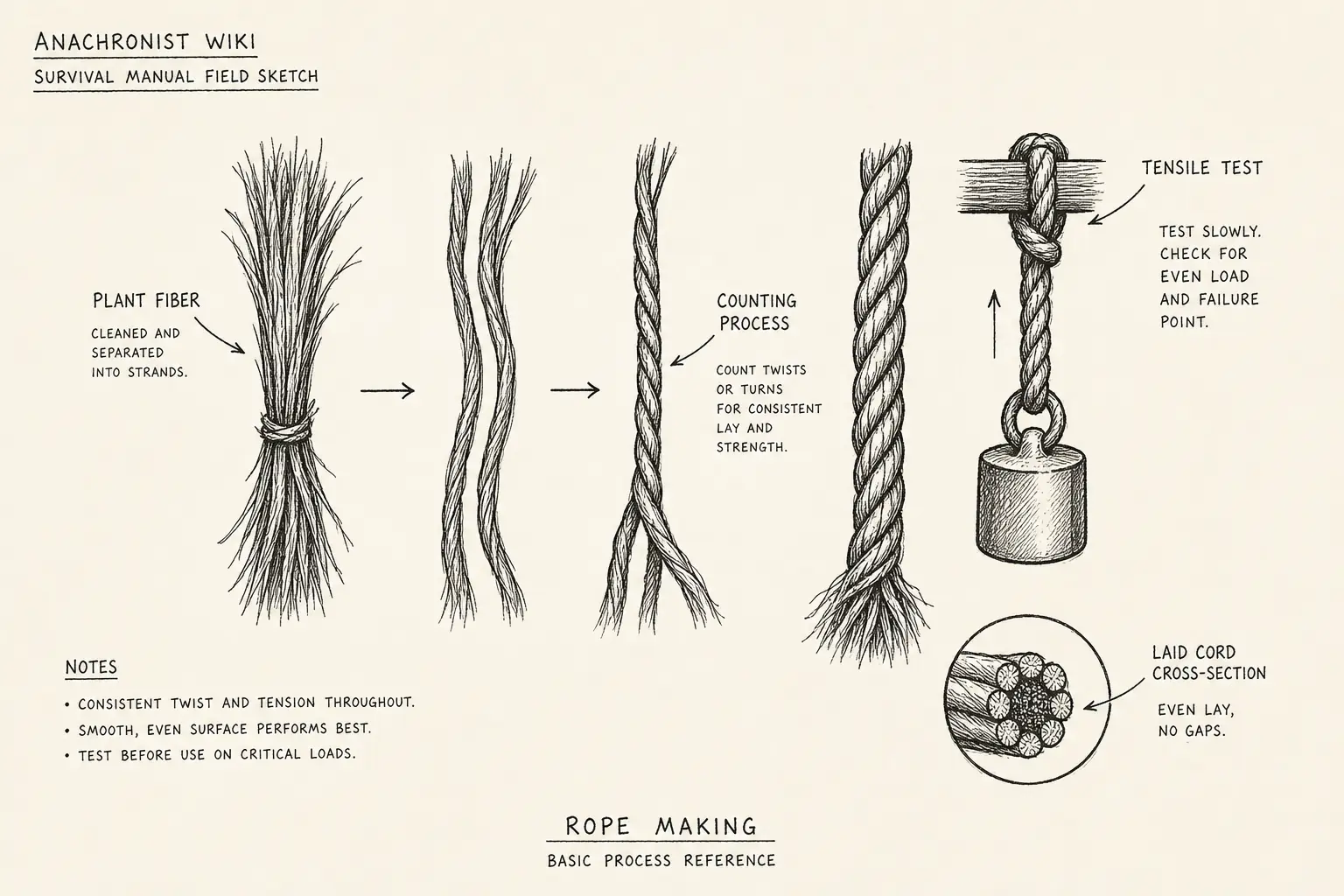
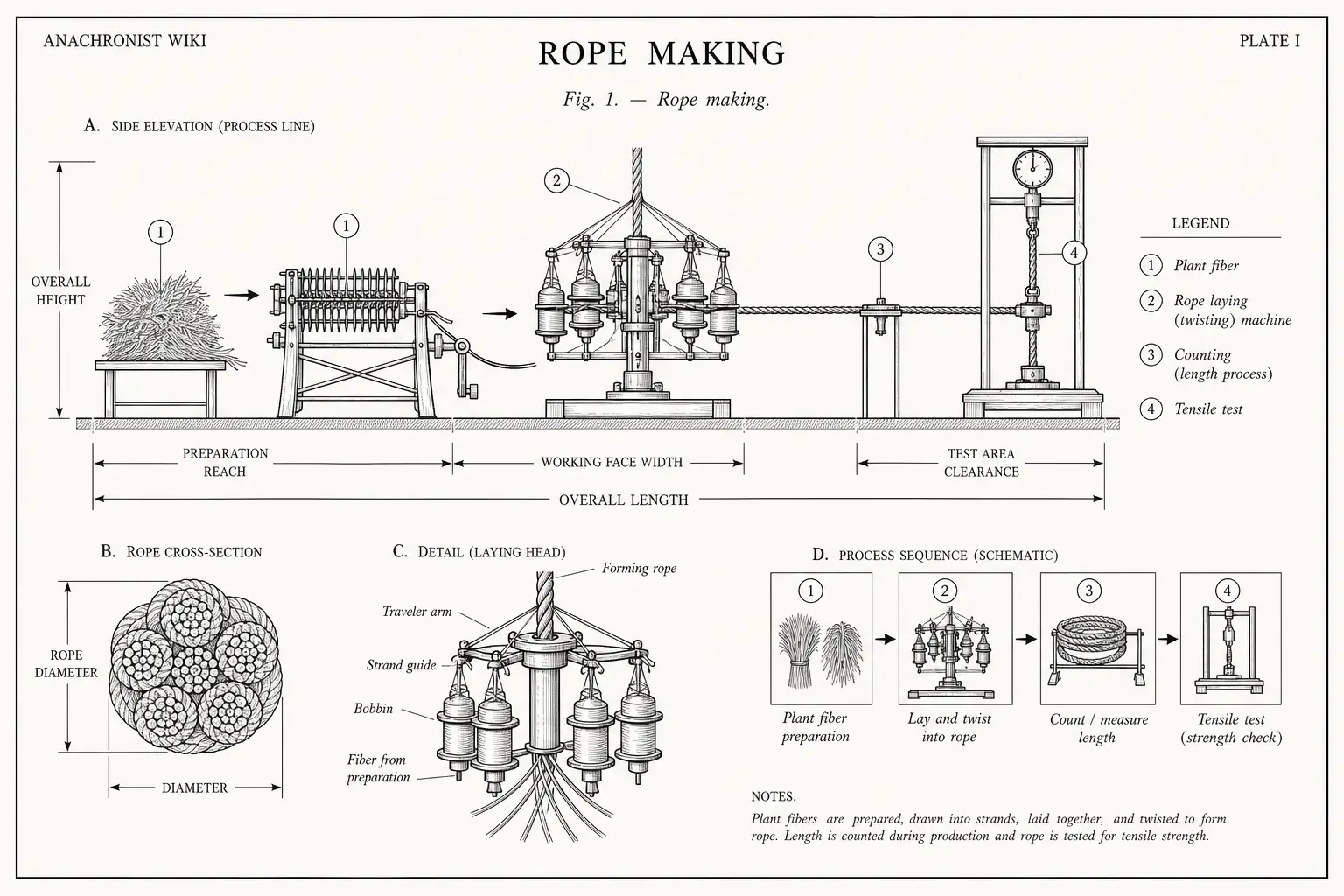
Prepare loose fibers, align them, twist or braid them into strands, combine strands into rope, and prove that the finished batch survives its intended use.
Minimum viable version
Hand-twisted two-strand cord is enough for binding bundles and teaching tension. It becomes rope only when the maker can repeat length, twist, and strength across samples.
Better versions
Better rope making uses combed fiber, fixed hooks, steady tension, opposing twist, sample labels, and proof loads from tensile testing.
Prerequisite tree
- Counting for strand counts and batch labels.
- Tensile test for comparing samples.
- Standard weights when proof loads need to be repeatable.
Materials and sourcing
Start with long fibers that bend without snapping. Candidate sources include retted flax, hemp if cultivated or traded, nettle, tree bast, grasses, animal hair, or sinew. Each source needs local testing because strength, rot resistance, and preparation labor vary.
In Arthurian Britain-like settings, flax and nettle are plausible candidates; hemp and high-quality bast depend on local cultivation, trade, and season.
Tools and workshop requirements
Hands are sufficient for small cord. A production process benefits from combs, drying racks, hooks, a turning stick, a measured path, and a clean storage area.
Procedure
- Sort fibers by length and reject rotten or brittle material.
- Clean, dry, and align fibers before twisting.
- Twist small strands evenly under tension.
- Combine strands with opposing twist so the rope balances.
- Bind the ends and label the batch.
- Pull-test samples before using the batch for lifting or hauling.
Mechanism
Twist and friction make many fibers share load. Opposing twist in strands keeps the finished rope from immediately unwinding.
Verification and quality control
Compare several samples from the same batch. Useful rope fails at similar loads and fails in the body rather than always at the knot or end binding.
Failure modes
| Failure | Likely cause | Fix |
|---|---|---|
| Uneven diameter | Poor fiber sorting | Sort by length and thickness |
| Rope unwinds | Twist not balanced | Relay with opposing twist |
| Breaks at many weak spots | Rotten fiber | Improve sourcing and drying |
| Batch cannot be trusted | No records | Label samples and record tests |
Maintenance, repair, and iteration
Keep process samples. Store good and bad examples together with notes so apprentices learn the difference by sight and by test.
Teaching it to local collaborators
Teach with three samples: loose fiber, badly twisted cord, and tested rope. The contrast makes process discipline visible.
Historical plausibility
Rope making is highly plausible, but dependable production requires labor organization, fiber supply, drying space, and quality norms.
What this unlocks
Rope making unlocks rope, pulley systems, lifting gear, hauling, nets, rigging, and many temporary workshop fixtures.
Open questions and uncertainties
- Regional fiber candidates need source review.
- Future material pages should split flax, hemp, nettle, bast, hair, and sinew.
Sources and provenance
Generated seed draft for ANA-13. No source pack was used; specific claims need human source review.