Field briefing
Alignment checking is a small workshop habit with large effects. A crooked axle, fork, frame, or bearing wastes effort and breaks parts even when every individual part looks sound.
What you are trying to make
Create repeatable ways to compare the intended line of a part with its actual line.
Minimum viable version
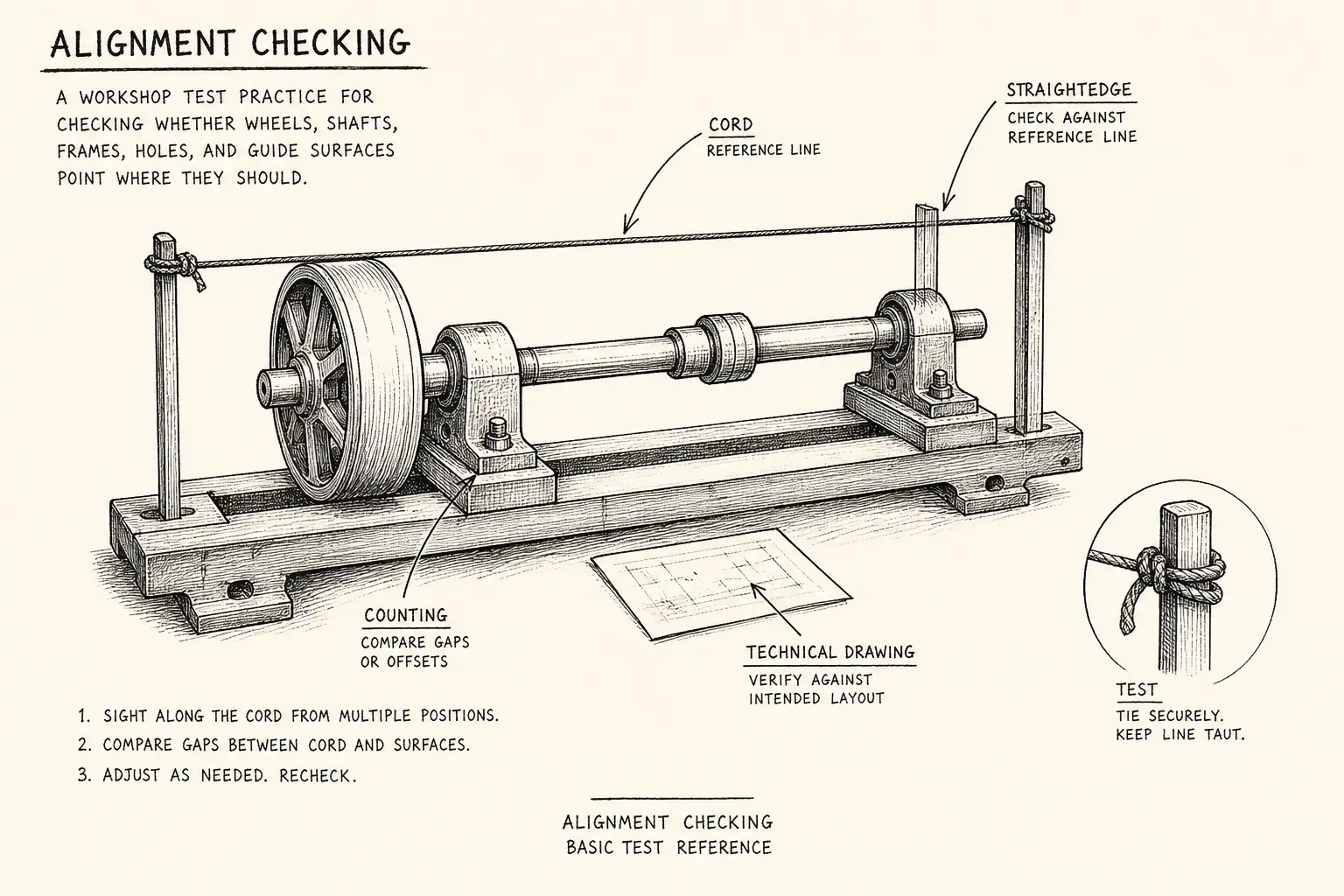
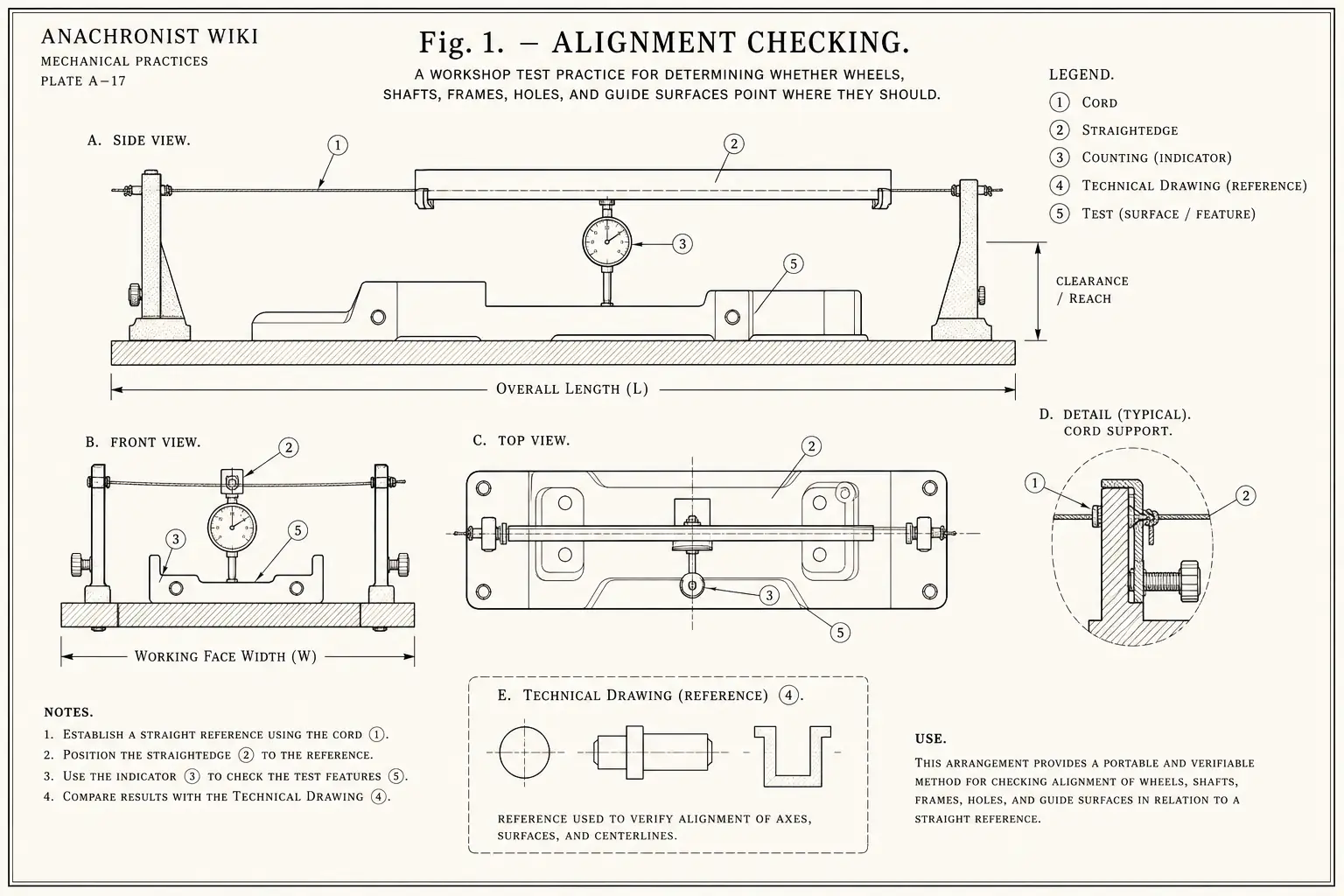
A taut cord, plumb line, straight board, and repeated marks can detect many problems: a wheel that wobbles, two axles that are not parallel, a frame that twists, or a hole that was bored off-line.
Better versions
Better checking uses jigs, fixed reference faces, dividers, marked rods, flat benches, templates, and written records of corrections.
Prerequisite tree
- Counting for repeated comparisons and labels.
- Technical drawing when the intended geometry is more complex than a single line.
- Standard weights where loaded alignment matters.
Materials and sourcing
The main materials are reference objects: cord, rods, straight boards, marked sticks, chalk or charcoal, and a stable surface. The reference must be protected from ordinary use or it stops being a reference.
Tools and workshop requirements
Tools include cord, plumb bob, straightedge, square-like corner reference, marking point, and a slow way to rotate wheels while observing the rim.
Procedure
- Decide which line matters: axle, rim, frame center, fork, or bearing.
- Set a stable reference line.
- Mark the part at several points.
- Rotate or load the part if movement matters.
- Record where it deviates.
- Correct a little, then repeat the check.
Mechanism
Alignment tests make hidden geometry visible by comparing a moving or assembled part against a simpler reference.
Verification and quality control
A good check gives the same result when repeated by another worker. If two people read the same frame differently, the reference setup is unclear.
Failure modes
| Failure | Likely cause | Fix |
|---|---|---|
| Reference moves | Poor setup | Anchor the cord or board better |
| Test gives different answers | Ambiguous marks | Label points and repeat from both sides |
| Loaded part changes shape | Weak frame | Test under realistic load before approval |
| Correction over-shoots | Too much material removed | Correct in small passes |
Maintenance, repair, and iteration
Store straightedges and jigs carefully. Mark damaged references as scrap so they do not silently corrupt future work.
Teaching it to local collaborators
Show a wheel that looks round by eye but wobbles against a fixed pointer. The demonstration makes checking feel useful instead of fussy.
Historical plausibility
Alignment checking is plausible wherever workshops make wheels, looms, doors, frames, mills, or vehicles. Formal precision tools come later, but reference lines are early.
What this unlocks
Alignment checking unlocks more reliable plain bearings, spoked wheels, carts, potter’s wheels, and bicycles.
Open questions and uncertainties
- Future pages should cover straightedge making, squares, plumb bobs, and surface plates.
Sources and provenance
Generated expansion for ANA-34. No source pack was used; specific historical and technical claims need human source review.