Field briefing
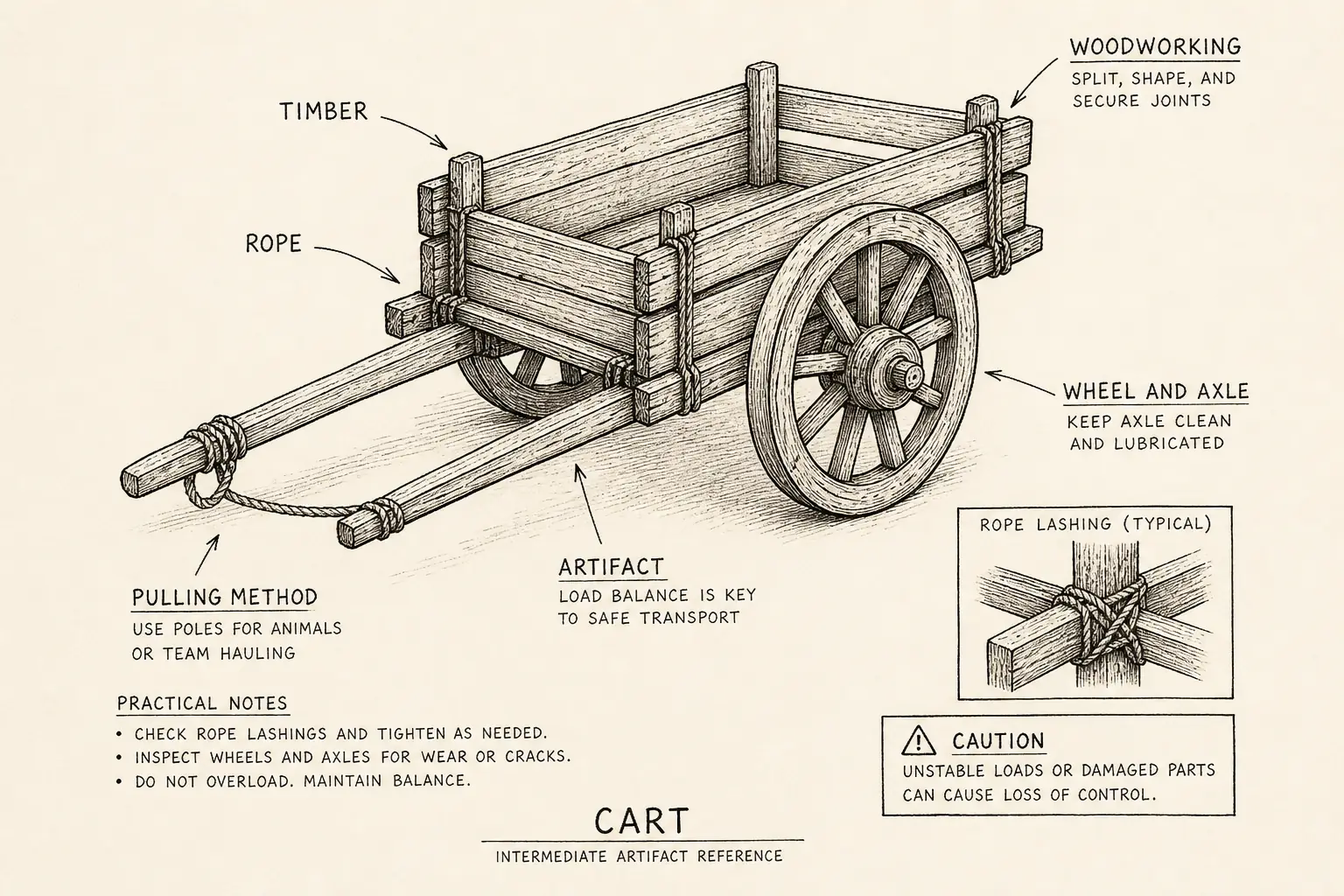
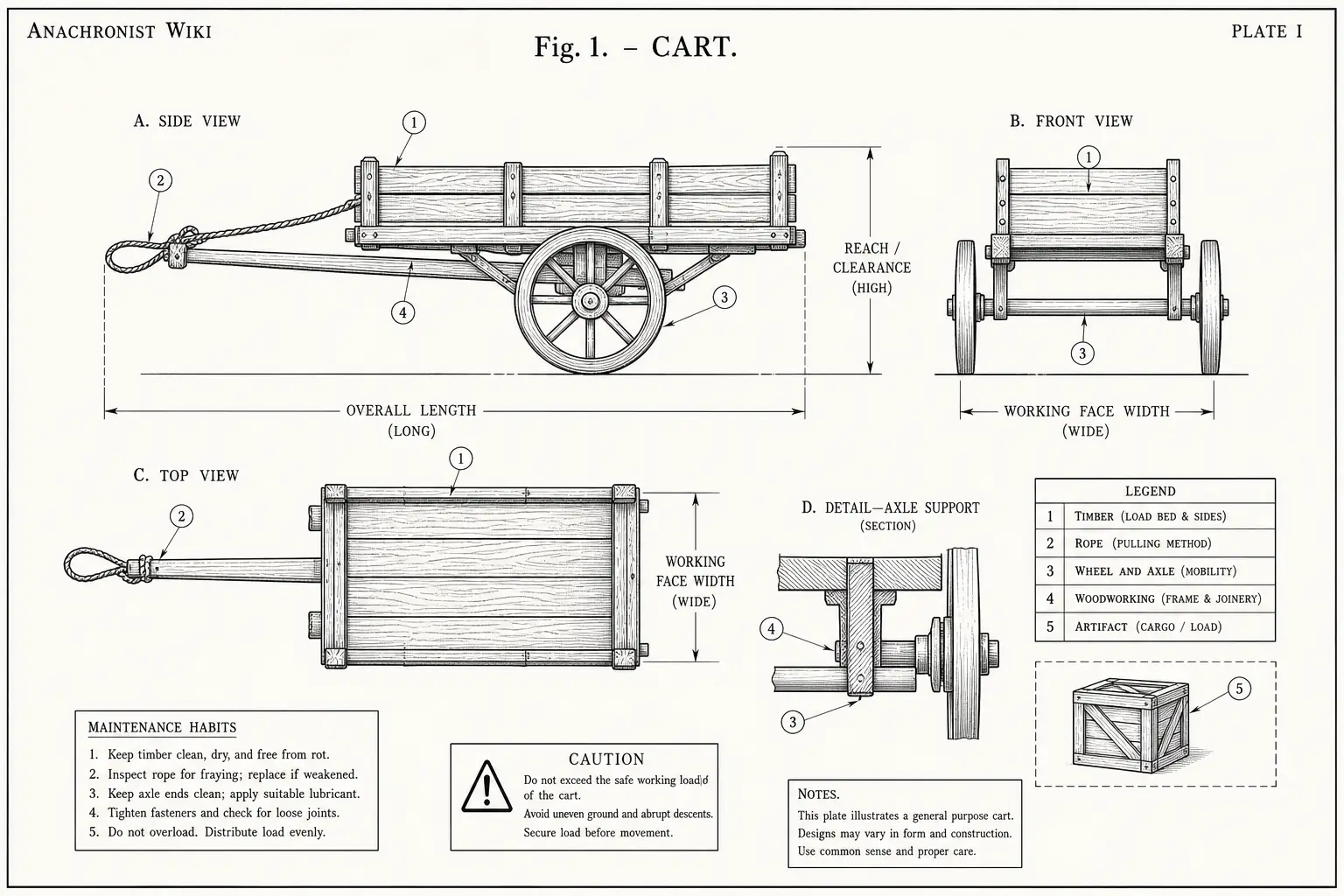
A cart turns the wheel and axle into a useful transport system. It needs a frame that holds load, wheels that stay aligned, a pulling method, and ground that rewards rolling instead of dragging.
What you are trying to make
Make a wheeled carrier that moves repeated loads with less effort than carrying or dragging them.
Minimum viable version
A two-wheeled handcart with solid or spoked wooden wheels, a simple bed, and handles can be useful around a workshop, field, or road.
Better versions
Better carts add stronger hubs, better bearings, draft-animal harness points, brakes, removable sides, and standardized repair parts.
Prerequisite tree
- Wheel and axle for rolling support.
- Woodworking for the frame and bed.
- Plain bearing for repeated use.
- Alignment checking for parallel wheels.
- Rope for load security and field repair.
Materials and sourcing
Timber choice controls durability. Axle supports and wheel hubs need stronger stock than side boards. Rope, leather, pegs, wedges, and metal straps can all help secure loads or reinforce weak joints.
Tools and workshop requirements
Tools include woodworking tools, boring tools, wedges, cord, straightedge, and a test path. A mature cart culture also needs storage, repair habits, and rules about load limits.
Hazards and controls
Heavy loads can crush feet, run downhill, or break frames. Test on level ground, keep people out of the path, and secure loads before moving.
Procedure
- Build and test the wheels.
- Build a frame that holds the axle square.
- Fit the load bed over the axle line.
- Add handles, shafts, or pulling rope.
- Test unloaded, then with small repeated loads.
- Inspect joints and hubs after every early run.
Mechanism
The cart concentrates rubbing at the axle and rolling contact at the wheels. It works best when the load sits where the frame can carry it without twisting.
Verification and quality control
Pull the cart empty and loaded over the same path. Watch for wheel scrub, axle heating, frame twist, load shifting, and handle strain.
Failure modes
| Failure | Likely cause | Fix |
|---|---|---|
| Cart drags sideways | Wheels not parallel | Re-align axle supports |
| Hub heats | Bearing rough or overloaded | Smooth, lubricate, or reduce load |
| Frame cracks | Load concentrated badly | Add braces or change bed layout |
| Load spills | No tie-down habit | Add sides or lashings |
Maintenance, repair, and iteration
Keep hubs clean, tighten wedges, inspect frame corners, and store the cart dry. Track which loads break which parts.
Teaching it to local collaborators
Teach loading first. A good cart used badly fails like a bad cart.
Historical plausibility
Carts are plausible in settled settings with paths, workshops, repeated loads, and animals or labor organization. Rough ground can erase the advantage.
What this unlocks
Carts unlock heavier workshop supply chains, road maintenance incentives, market transport, and wheelwright specialization.
Open questions and uncertainties
- Local terrain and draft-animal availability need source review.
- Future pages should split harness, brake, road building, and wheelwright guild practice.
Sources and provenance
Generated expansion for ANA-34. No source pack was used; specific historical and technical claims need human source review.