Field briefing
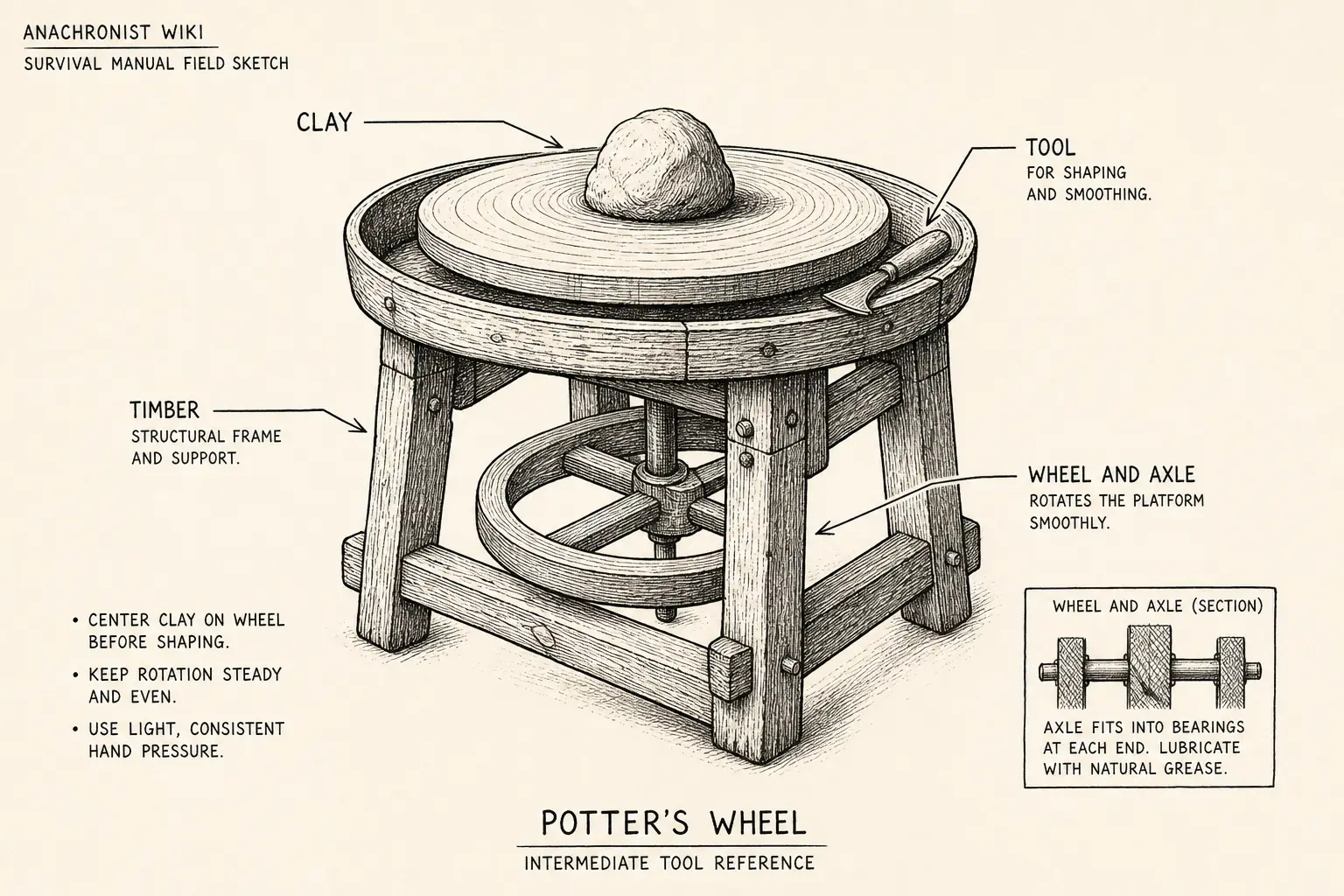
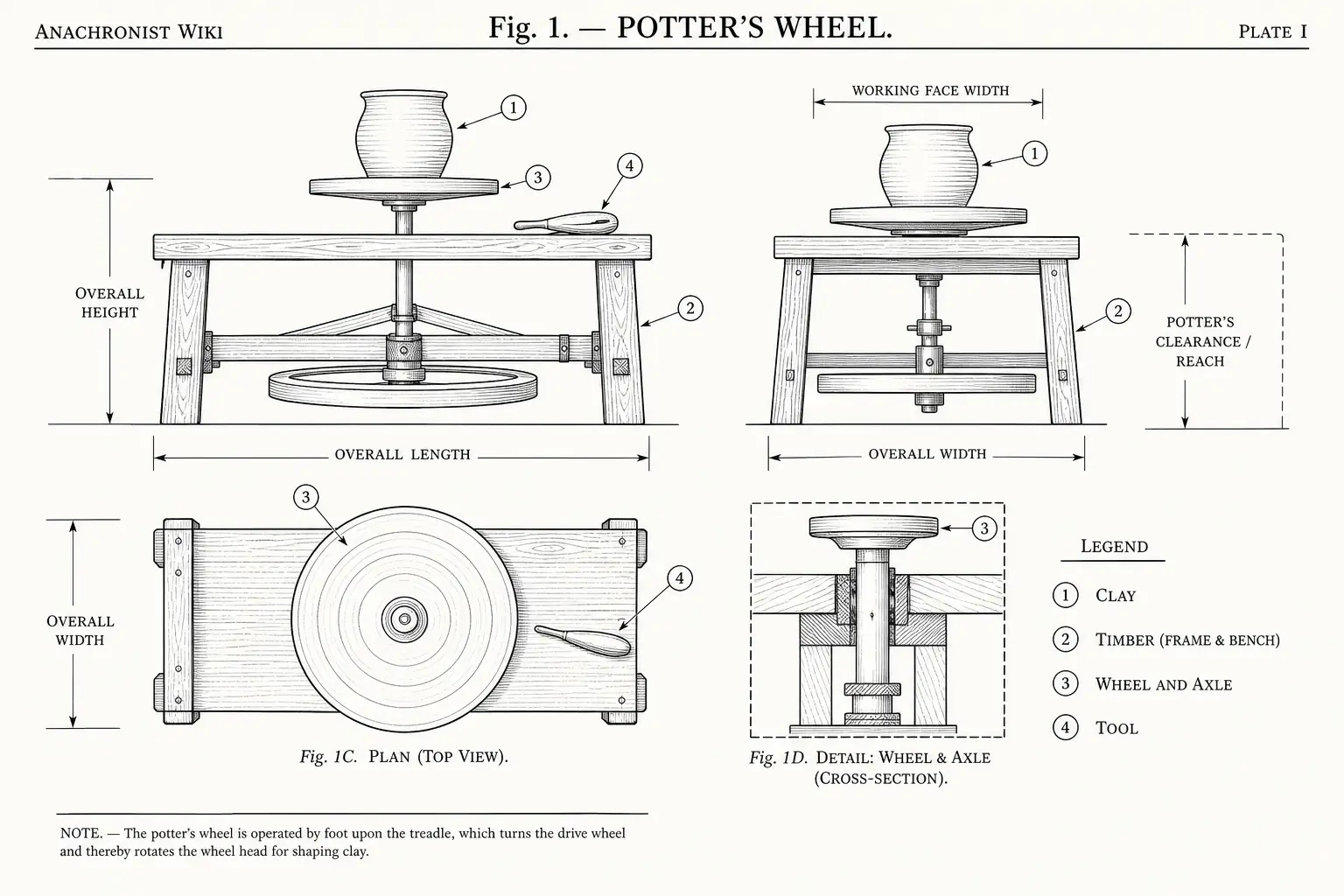
A potter’s wheel applies wheel and axle mechanics to clay shaping. It is a workshop tool for symmetry, speed, and repeatable vessel forms.
What you are trying to make
Make a stable rotating platform that can spin smoothly enough for a potter to shape prepared clay with both hands.
Minimum viable version
A slow hand-turned wheel or tournette can support finishing and symmetrical shaping. A heavier kick wheel or flywheel gives steadier rotation but demands better bearings and frame strength.
Better versions
Better versions add heavier flywheels, smoother bearings, foot drive, level work surfaces, splash control, and standardized clay preparation.
Prerequisite tree
- Wheel and axle for the rotating platform.
- Clay for the material supply.
- Woodworking for the frame and disk.
- Plain bearing for smoother rotation.
- Alignment checking for wobble control.
Materials and sourcing
The wheel can be wood, stone, or fired clay, depending on local materials and desired mass. The frame must resist rocking. Clay must be cleaned and wedged enough that hard inclusions do not spoil the vessel while spinning.
Tools and workshop requirements
Tools include shaping tools, water vessel, prepared clay storage, wheel frame, bearing surface, and drying shelves. The workshop needs a clean floor and enough teaching time for hand pressure control.
Procedure
- Build a stable base and vertical shaft or pivot.
- Fit a round work surface to the shaft.
- Smooth and lubricate the bearing surface.
- Check wobble with the wheel empty.
- Test with scrap clay before production.
- Clean clay and grit from the bearing area after use.
Mechanism
Rotation lets the potter apply steady pressure around the full circumference. A heavier wheel stores momentum and smooths uneven pushes.
Verification and quality control
Spin the wheel empty and watch the edge against a fixed point. Then center scrap clay and check whether the wheel slows, wobbles, or shifts under hand pressure.
Failure modes
| Failure | Likely cause | Fix |
|---|---|---|
| Wobble | Off-center disk or shaft | Recenter and check alignment |
| Stops quickly | High bearing friction | Smooth, clean, and lubricate |
| Frame rocks | Weak base | Widen or brace frame |
| Clay scratches | Poor preparation | Clean and wedge clay better |
Maintenance, repair, and iteration
Keep grit out of the bearing. Flatten or replace the work surface when it warps. Save successful vessel profiles as teaching references.
Teaching it to local collaborators
Teach centering first. Without centering, speed only makes mistakes happen faster.
Historical plausibility
Potter’s wheels are ancient, but useful production depends on prepared clay, workshop training, drying space, and firing capacity.
What this unlocks
Potter’s wheels unlock more repeatable vessels, faster ceramic production, mold making, and stronger demand for kiln control.
Open questions and uncertainties
- Future pages should split tournette, kick wheel, clay wedging, and ceramic firing schedules.
Sources and provenance
Generated expansion for ANA-34. No source pack was used; specific historical and technical claims need human source review.