Field briefing
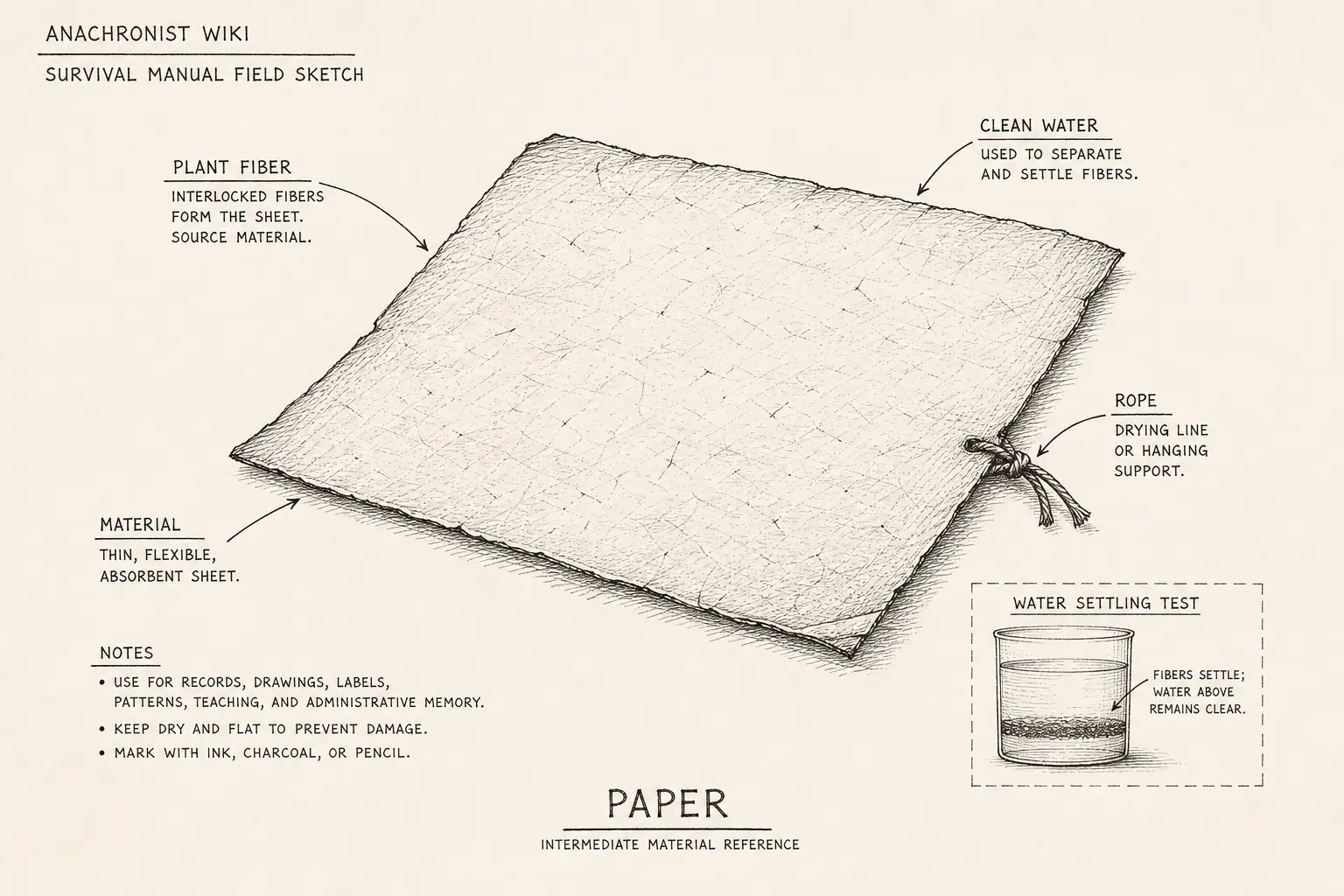
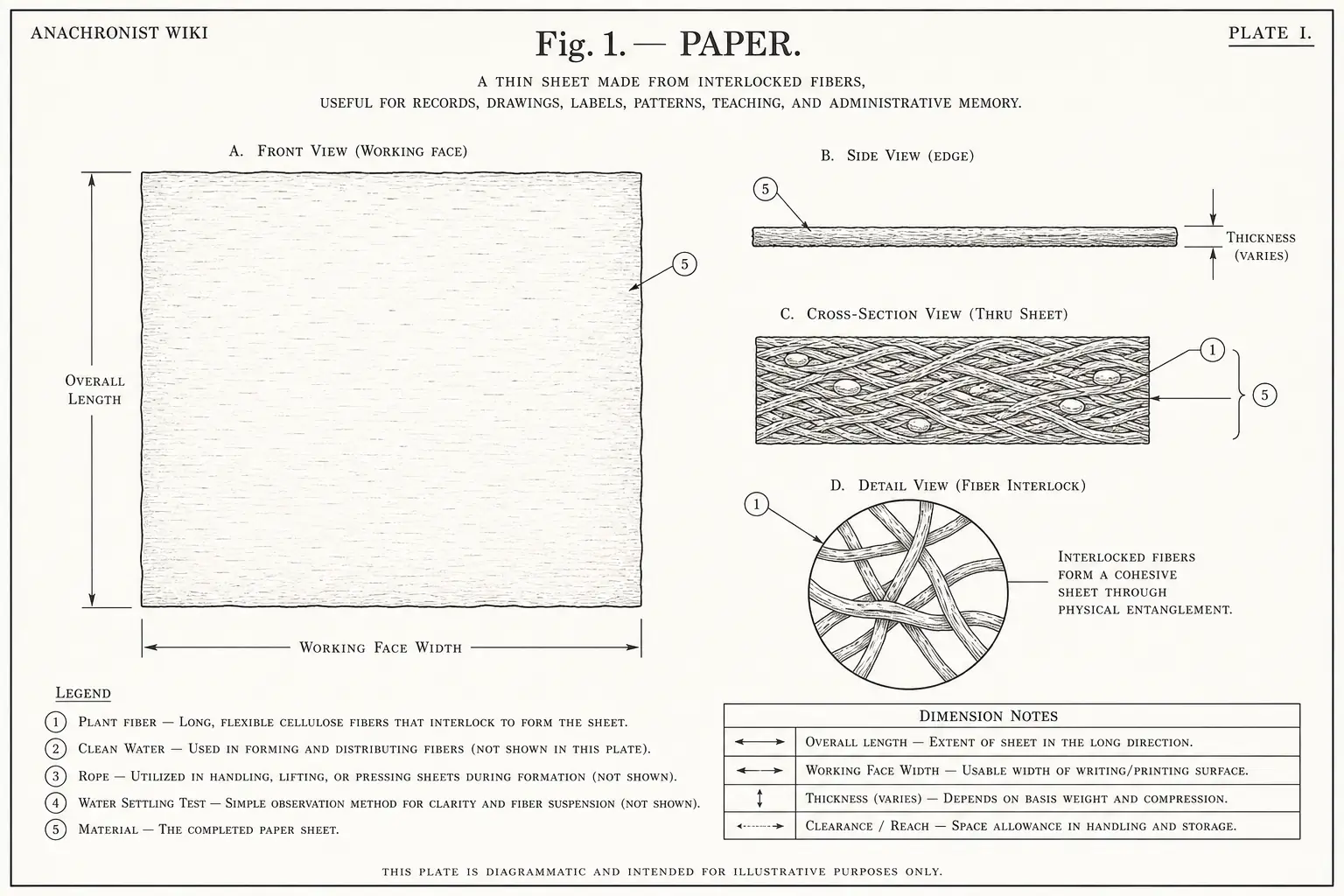
Paper is a social technology as much as a sheet. It becomes valuable when a workshop or institution needs many cheap records, patterns, labels, and drawings.
What you are trying to make
Make a thin mat of beaten fibers that can dry into a flexible writing or drawing surface.
Minimum viable version
A rough sheet from reused fiber can carry marks and labels even if it is thick, uneven, and weak.
Better versions
Better paper needs cleaner fiber, more even pulp, a screen mold, controlled drying, sizing if ink feathers, and records of batches.
Prerequisite tree
- Rope and fiber preparation.
- Writing to create demand and evaluate the surface.
- Ink or another marking system for compatibility tests.
Materials and sourcing
Useful feedstocks include linen rags, worn cordage, bast fibers, and other plant fibers that can be separated into fine strands. Rag collection is an institutional prerequisite: without a collection habit, the feedstock is unreliable.
In Arthurian Britain-like conditions, paper is not the first record medium. Wax tablets, parchment, wood, or clay may be easier in some places. Paper becomes plausible where fiber, water, labor, and demand align.
Tools and workshop requirements
Tools include soaking vats, beaters, a screen or woven mold, felts or cloths, boards, drying space, and clean storage. A workshop must keep grit, food waste, and ash out of pulp.
Procedure
- Sort fibers and remove rotten, greasy, or gritty pieces.
- Soak and beat the fiber until it disperses in water.
- Pull a thin layer on a screen or woven mold.
- Drain, couch onto cloth, press by weight, and dry flat.
- Test with the intended ink or marking tool.
Mechanism
Fine wet fibers overlap randomly. As water leaves, fiber contact and surface chemistry hold the sheet together.
Verification and quality control
Check whether the sheet tears during handling, accepts ink without severe feathering, lies flat enough for technical drawing, and can be stored without mold.
Failure modes
| Failure | Likely cause | Fix |
|---|---|---|
| Sheet falls apart | Fibers too short or unbeaten | Improve fiber prep |
| Ink feathers | Too absorbent or unsized | Use thicker ink or investigate sizing |
| Grit scratches pen | Dirty water or poor sorting | Settle and filter better |
| Mold appears | Stored damp | Dry longer and ventilate storage |
Maintenance, repair, and iteration
Store finished sheets dry and flat. Keep sample books by batch, with notes about fiber source and ink behavior.
Teaching it to local collaborators
Teach papermaking through labels and accounting first. The value becomes obvious when the workshop can find old batch notes.
Historical plausibility
Paper is possible earlier than its local adoption in many places, but economics, trade, record culture, and competing media determine whether it spreads.
What this unlocks
Paper unlocks cheap records, technical drawings, labels, patterns, teaching sheets, and later printing.
Open questions and uncertainties
- The historical availability of suitable fibers and screens needs review.
- A page on parchment should exist as an alternative record medium.
Sources and provenance
Generated seed draft for ANA-13. No source pack was used; specific claims need human source review.