Field briefing
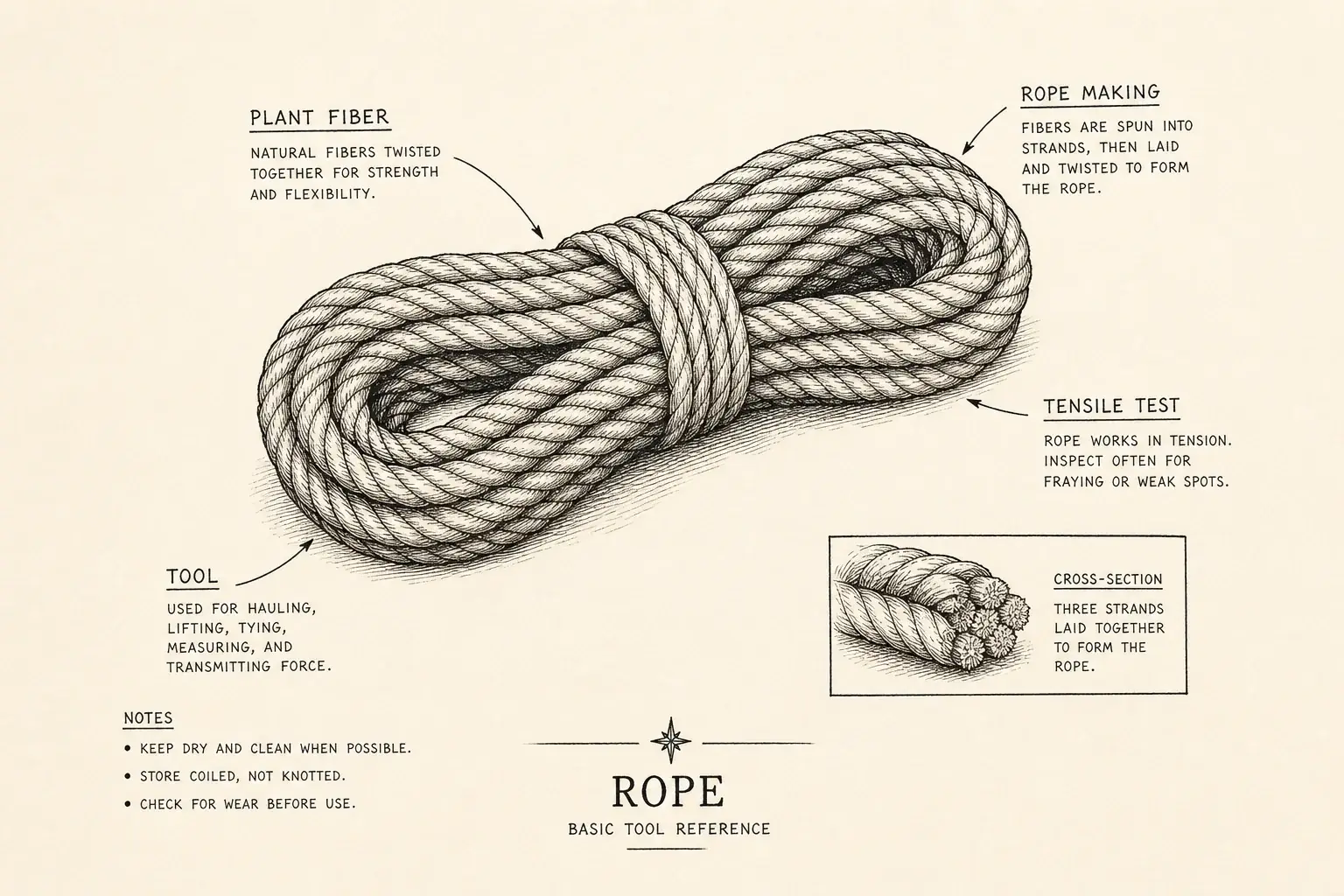
Rope is a force path. It lets people pull from a safer place, bind parts together, hang weights, and use pulleys or windlasses.
What you are trying to make
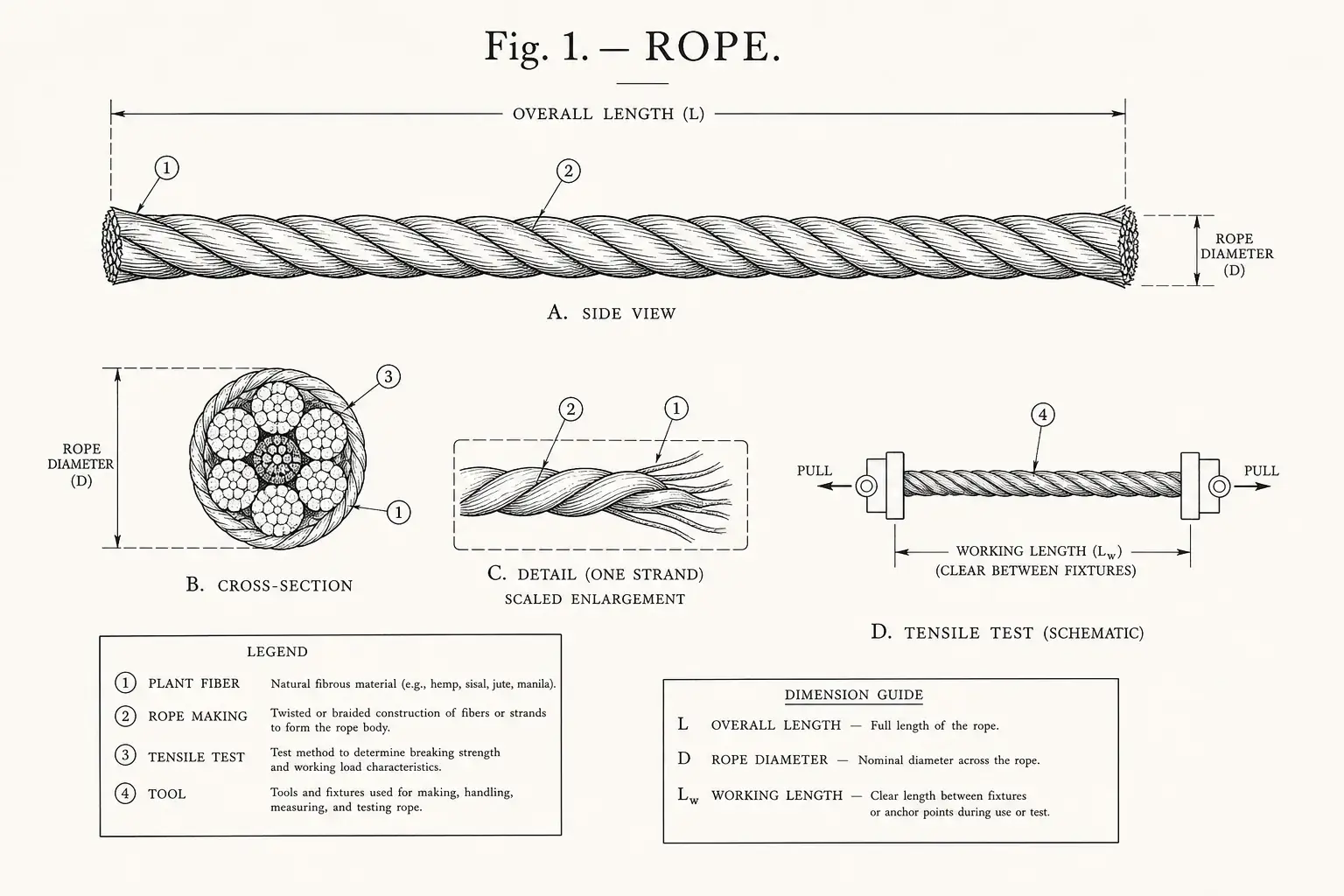
Make many weak fibers behave like one strong flexible member by twisting or braiding them so load spreads along the length.
Minimum viable version
Hand-twisted cord from prepared plant fiber is enough for tying bundles and light hauling. A working rope needs consistent fiber, even twist, and a known safe load.
Better versions
Better cordage uses longer fibers, even drying, opposing twists in strands, and a ropewalk or fixed hooks to maintain tension while laying the rope.
Prerequisite tree
- Tensile test for checking batches.
- Counting for tracking strand count and test results.
- Standard weights for repeatable proof loads.
Materials and sourcing
Plant fibers are the main supply chain. Look for stems or bark that peel into long, tough strips. Useful fiber resists snapping when bent sharply and can be scraped clean without turning to powder.
In an Arthurian Britain-like setting, likely candidates include flax where cultivated, nettle, hemp if present through cultivation or trade, and bast from suitable tree bark. Animal hair and sinew work for smaller cords but are less convenient for long hauling rope.
Preparation usually means retting or soaking to loosen fiber, scraping away weak material, drying, combing, and sorting by length. The seed page does not settle exact species; each fiber source deserves its own page.
Tools and workshop requirements
Hands can twist small cord. Longer rope benefits from hooks, a swivel or turning stick, a comb, a drying rack, and a clean place to keep grit out of the fibers.
Procedure
- Sort fibers by length and remove rotten or brittle pieces.
- Twist a small strand and pull it until it fails.
- Lay multiple strands with opposite twist so the rope does not immediately unwind.
- Keep tension steady while twisting.
- Finish the ends with binding so the rope does not unravel.
Mechanism
Twist creates friction and geometry that keep fibers sharing load. Too little twist slips. Too much twist kinks and weakens the rope.
Verification and quality control
Proof each rope with a repeatable load before trusting it overhead. Watch for necking, strand breakage, crackling fiber, sudden stretch, or unraveling at the ends.
Failure modes
| Failure | Likely cause | Fix |
|---|---|---|
| Rope snaps suddenly | Rotten or short fibers | Improve sorting and use more strands |
| Rope stretches and thins | Weak preparation or wet fiber | Dry and retest before use |
| Rope kinks | Too much twist or uneven tension | Relay under steadier tension |
| Surface abrades | Rough pulley or grit | Smooth contact points and keep clean |
Maintenance, repair, and iteration
Dry rope after use, store it off damp ground, and retire sections with broken strands. Splicing and whipping ends are early improvements.
Teaching it to local collaborators
Start with two people twisting grass or bast, then show how opposite twist locks the rope. Keep a broken sample as a teaching aid.
Historical plausibility
Cordage is ancient, but reliable lifting rope needs disciplined fiber preparation and batch testing. The bottleneck is often labor and quality control, not the idea.
What this unlocks
Rope unlocks hauling systems, pulleys, suspended standard weights, traps, tents, rafts, and workshop lashing.
Open questions and uncertainties
- Local species and cultivation history need source review.
- Future material pages should separate flax, hemp, nettle, bast, hair, and sinew.
Sources and provenance
Generated seed draft for ANA-13. No source pack was used; specific claims need human source review.